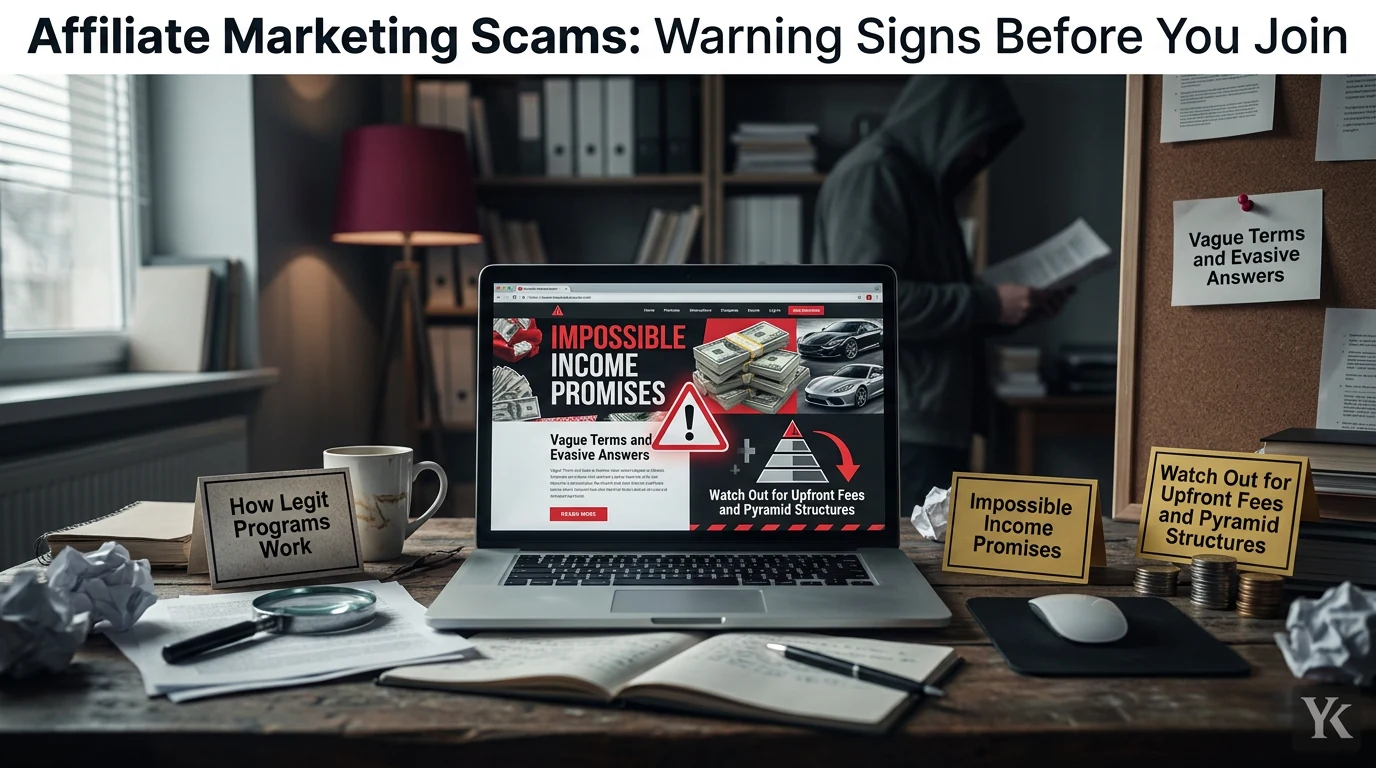
Most affiliate programs are legitimate. But the ones that aren't can cost you real money, your reputation, and in some cases, a letter from the FTC.
Affiliate marketing scams have grown more sophisticated alongside the industry itself. The global affiliate channel keeps expanding, and wherever there's a commission structure, there are people trying to game it. Whether you're a blogger evaluating your first program or a creator who's been burned before, the red flags are consistent enough that you can screen for them before you commit a single piece of content.
How Legit Programs Work
A legitimate affiliate program pays you a commission when someone you refer takes a defined action, usually a purchase or a qualified lead. The merchant sets the terms, tracks conversions through a unique link or cookie, and pays out on a schedule. Commission rates vary by vertical: physical goods often run 1-10% (Amazon Associates' standard rates run from 0% to 10% depending on category), digital products and SaaS can run higher, and lead-gen programs pay per form fill or call.
Standard programs have clear terms of service, a real contact point for affiliate support, and a tracking dashboard you can actually read. Payouts happen on a predictable schedule, typically on a net basis within a defined window. The merchant wants you to succeed because your conversions are their revenue. That alignment matters.
When that alignment breaks down, or when it never existed in the first place, everything else unravels.
Impossible Income Promises
If the program's recruitment page leads with screenshots of wire transfers, "passive income" claims, or language guaranteeing a specific daily income, stop there. No commission structure in the world guarantees income. Conversions depend on your traffic quality, your audience fit, and the product's actual appeal.
The programs that shout the loudest about earnings are usually the ones with the least to show for it. Legitimate networks let the commission rate and product speak for themselves. Scammy ones need to manufacture excitement because the underlying offer can't hold up to scrutiny.
Check whether any income claims are backed by an income disclosure statement. If a program makes specific earnings claims and buries or omits the disclosure, that's a compliance problem on their end that can become your legal exposure.
Watch Out for Upfront Fees and Pyramid Structures
Legitimate affiliate programs don't charge you to join. Full stop. Some premium networks have an application process or require a minimum traffic threshold, but they don't ask you to buy a "starter kit," pay an "activation fee," or purchase the product at a special "affiliate price" before you can promote it.
The moment a program's pitch shifts from "what you earn per sale" to "how much you earn per person you recruit," you're looking at a structure that resembles a pyramid scheme more than an affiliate program. Wecantrack's affiliate scam overview lists an "emphasis on recruitment over product sales" among its red flags. When recruiting is the main way to earn, the program's economics depend on expansion rather than product sales.
Real affiliate programs make money when customers buy. Pyramid-adjacent schemes make money when new affiliates join. That's a fundamental difference in who the program is actually serving.
Vague Terms and Evasive Answers
Read the terms of service before you apply. If there are no terms, that's the red flag. If the terms exist but are vague about payout thresholds, cookie duration, what counts as a qualifying conversion, or what can get your account terminated, treat that vagueness as intentional.
If a program dodges your questions or keeps details vague, treat that as a warning sign. Email the affiliate manager before you join. Ask about cookie duration, last-click versus multi-touch attribution, and what happens to your commissions if a customer refunds. A legitimate program answers these questions directly. A bad one deflects, sends you back to the FAQ, or takes two weeks to respond.
Common transparency failures to watch for:
- No named contact for affiliate support
- Payout minimums that reset on technicalities
- Terms that let the merchant retroactively void commissions
- No clear explanation of how conversions are attributed
- Vague language around "fraud" that gives the merchant discretion to reject any commission
The Hostinger affiliate scam guide treats a merchant with no verifiable company history or address as a serious red flag, and says to confirm the merchant actually exists before you join.
Fraud Signals in Traffic and Conversions
This one cuts both ways. You can be the victim of a fraudulent program, but you can also unknowingly promote a program that attracts fraudulent traffic, which can get your account flagged or terminated.
A 2026 affiliate fraud guide from FirstPromoter warns that "sudden spikes in click volume that do not correspond to conversion rate improvements are a common fraud signal." If a program's dashboard shows hundreds of clicks with near-zero conversions, something is wrong, either with the tracking, the landing page, or the traffic quality in the network.
Specific patterns to watch for:
- Click volume spikes overnight with no matching conversion lift
- Your conversion rate drops sharply with no change in your traffic, which Hostinger's guide ties to cookie manipulation
- Approved commissions vanish without explanation (commission shaving)
- Conversions that come in waves and then trigger chargebacks months later
- One affiliate in a network dramatically outperforming peers with no explainable reason
Anura's fraud signal guide flags both outsized conversion rates and rising chargebacks from the same affiliate cohort, and notes that fraud chargebacks usually arrive months later, long after the affiliates were paid. If you're evaluating a network and you see chargeback rates mentioned anywhere in affiliate forums, take it seriously.
Rewardful's fraud detection breakdown details what cookie stuffing and bot-driven click fraud look like at the traffic level. Worth reading before you commit to any new network.
Misaligned Commission Structures
Hamster Garage's affiliate agency red-flags guide sums up the structural problems as "misaligned incentives, weak measurement, and poor partner quality control." When a program's commission structure rewards volume over quality, you get exactly that: volume with no downstream value.
Watch for these structural problems:
- Revenue-only deals with no regard for refund rates or customer lifetime value
- Commissions so high they're economically irrational, which often signals the product is overpriced or the merchant expects high chargeback rates
- Vanity metric reporting that shows impressions and clicks but hides conversion-to-sale ratios
The programs worth staying in long-term track incremental value, not just last-click attribution. Ask whether commissions pay on new customers only and how returning customers are credited. A program that can't answer is measuring too shallowly to trust.
FTC Compliance Failures Are Your Problem Too
Joining a program that ignores disclosure requirements doesn't just expose the merchant to risk. It exposes you.
The FTC treats influencers and content creators as endorsers. Any affiliate link in a blog post, social caption, or video description requires a clear and conspicuous disclosure. "Clear and conspicuous" means hard to miss: close to the recommendation and before the affiliate link, not buried in a footer or lost among other hashtags.
The penalty numbers are not abstract. The maximum civil penalty is $53,088 per violation, unchanged for 2026. The FTC can seek it where penalties apply, for example against a company that received its Notice of Penalty Offenses on endorsements and kept going. In December 2025 the FTC sent warning letters to ten companies over deceptive review practices under its Consumer Review Rule, a signal that enforcement is stepping up.
Attribloom's 2026 disclosure guide spells out why the per-violation count matters: "Because it is charged per violation, exposure aggregates across many posts and affiliates rather than being a single fine." If you've published 50 posts promoting a program that told you disclosures were optional, that is 50 potential violations, not one.
When evaluating a program, ask directly whether they provide disclosure guidance. Check whether their existing affiliates are disclosing properly. If their top publishers aren't disclosing and the program manager shrugs when you raise it, walk away. You're not just taking on their compliance sloppiness, you're absorbing their legal risk.
The marketer.law FTC compliance guide breaks down current disclosure rules in plain language and is worth bookmarking before you publish anything affiliate-related. For wording and placement on your own posts, see our affiliate link disclaimer guide.
Bad Product, Bad Brand
A low-quality product creates downstream problems that no commission rate compensates for. Your audience trusts your recommendations. One bad product recommendation can cost you more in credibility than the commission earns you.
Check these before promoting anything:
- Product reviews on independent platforms (Trustpilot, Reddit, app stores), not the merchant's own site
- Affiliate forum threads about the program, specifically around payment reliability
- The merchant's website quality, because an outdated, poorly maintained site signals the operation isn't serious
- Refund and return policy, because a program with a short refund window and high refund rates will claw back your commissions
Programs that advertise unusually high commission rates alongside "done-for-you" systems, have no verifiable company details, and attract complaints about delayed or missing payments are running a composite of nearly every red flag on this list. The Hostinger guide says a program that keeps delaying payment, quietly changes commission rates or removes approved commissions without explanation should be abandoned immediately.
Vetting Checklist
Run every new program through this before you commit:
- Search the program name + "scam" and "not paying" on Google and Reddit
- Read the full terms of service, specifically around commission voidance, fraud definitions, and payout thresholds
- Email the affiliate manager with a specific question about attribution and cookie duration, gauge response time and quality
- Check existing affiliates' disclosures to see whether the program enforces FTC compliance
- Look up the company on LinkedIn, Crunchbase, or a business registry to verify it's a real operation
- Start with a small test, a few posts or a limited paid campaign, before committing markedly more content or budget
- Set a monitoring baseline for click-to-conversion ratio in your first few weeks, flag anything that deviates markedly
- Check chargeback mentions in affiliate communities for the specific network or merchant
The same discipline applies whether you're running organic content or paid traffic. Native Ads Affiliate Marketing covers how to structure a test campaign before scaling, and the same logic applies here: don't commit volume to any program until you've validated the conversion quality.
Building a Sustainable Affiliate Stack
The answer to affiliate marketing scams isn't paranoia, it's process. Reputable networks like CJ Affiliate, Impact and Awin (which absorbed ShareASale in 2025) have compliance standards and merchant vetting that filter out the worst operators. They're not perfect, but they're a better starting point than cold outreach from a program you found in a Facebook group.
Diversify across programs rather than concentrating in one high-commission offer. A single program representing a dominant share of your affiliate revenue is a single point of failure. If that program changes terms, goes dark, or starts clawing back commissions, you have no fallback.
Monitor performance metrics that actually matter: conversion rate, average order value, refund rate, and earnings per click. Not just click volume. A program that sends you a lot of clicks but converts poorly is either mismatched to your audience or running low-quality traffic through the network. If you don't yet have your own click and conversion numbers to check against the program's dashboard, our free affiliate tracking software guide covers the options.
And stay current on FTC rules. The enforcement environment is not getting more lenient. The Chargebacks911 affiliate fraud detection guide covers the merchant-side signals worth understanding even as an affiliate, because knowing what merchants look for helps you avoid programs that attract fraud and protect your own account standing.
Frequently Asked Questions
Are all high-commission programs suspicious?
Not automatically. Some legitimate digital products and SaaS programs offer commissions well into the double digits because their margins support it. The real question is whether the commission rate makes economic sense for the product category. If a physical goods program is offering unusually high commissions, that's worth scrutinizing. If a software company is offering a meaningful recurring commission on a mid-tier subscription, that math can work. Always check the product's actual pricing and refund rate alongside the commission.
What should I do if a program stops paying?
Document everything first: screenshots of your dashboard, payout history, and any correspondence with the affiliate manager. Then escalate through the network if the program runs through one, because networks have leverage over merchants that individual affiliates don't. If you're dealing with a direct program and the merchant is unresponsive, post in affiliate communities with specifics, other affiliates will often have the same problem and collective visibility creates pressure. Small claims court can be an option if the amount is under your jurisdiction's limit, which is usually modest (California caps claims at $12,500 for individuals and $6,250 for businesses), and the merchant can be sued there.
Do I need an FTC disclosure even if I only mention a product in passing?
Yes, if you have a material connection to the brand through an affiliate agreement, you need a disclosure. "Material connection" includes any financial relationship, including commissions you might earn. The FTC's standard is whether a reasonable reader would want to know about the relationship, and they almost always would.
How do I tell an MLM from an affiliate program?
The test is simple: does the compensation structure require recruiting other participants to earn meaningfully? If yes, it's MLM-adjacent regardless of what the company calls it. A legitimate affiliate program pays you based on sales or leads you generate, full stop. Recruiting other affiliates might earn you a small override in a two-tier structure, but if recruitment is the primary income path, the product is secondary to the scheme.
Can I get in trouble for promoting a scammy program I didn't know was fraudulent?
Ignorance is partial protection but not complete protection. The FTC holds endorsers responsible for claims they make about products, so if you promoted a program making false product claims, you could face scrutiny even if you didn't know the claims were false. The practical defense is documented due diligence: show that you vetted the program, checked reviews, and disclosed your affiliate relationship properly. That paper trail matters if questions arise later.
Digital Marketing Technologist
Yosef Kassabry is a media buyer with 11+ years in paid acquisition for Arabic-speaking audiences across MENA and the Gulf. He runs paid media through direct buys and affiliate networks, and writes about ad platforms, tracking, native ads and affiliate marketing for people who run campaigns.