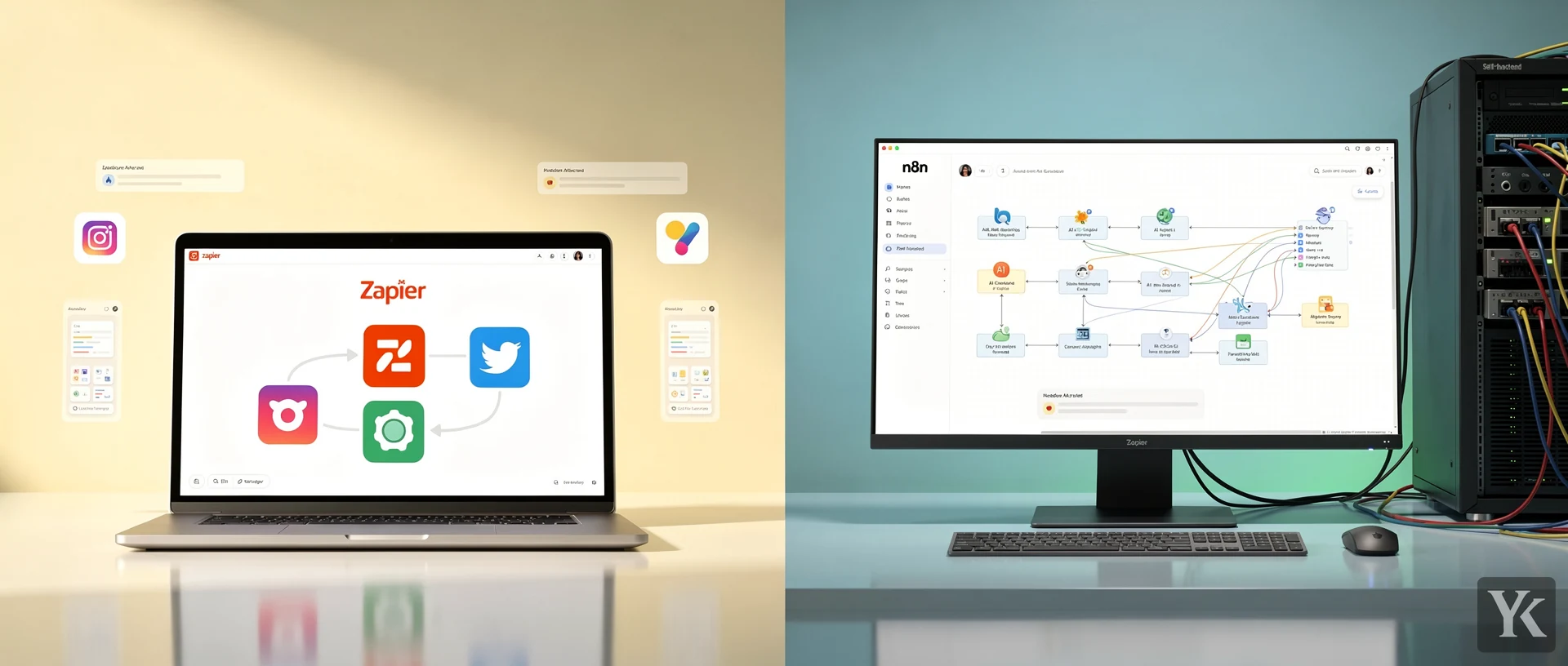
For AI automation workflows, the gap between these two platforms has never been wider. If you're automating basic SaaS connections, Zapier wins on speed. If you're building anything that resembles an AI agent or multi-step LLM pipeline, n8n is the only real option.
N8N vs Zapier AI workflows represent fundamentally different approaches to automation: Zapier offers cloud-based simplicity with 8,000+ prebuilt SaaS integrations optimized for non-technical teams, while n8n provides open-source flexibility with native AI agent orchestration, self-hosting capabilities, and execution-based pricing designed for complex, developer-driven workflows requiring full infrastructure control and advanced logic handling.
Quick Comparison: N8N vs Zapier
| Platform | Best For | Starting Price | AI Capabilities | Self-Hosting | Rating |
|---|---|---|---|---|---|
| n8n | Technical teams, AI agents, complex workflows | $20/month | Advanced (RAG, multi-agent, LangChain) | ✅ Yes | 4.7/5 |
| Zapier | Non-technical users, SaaS automation | $19.99/month | Basic (prompt-in/out only) | ❌ No | 4.5/5 |
N8N vs Zapier AI Workflows: Architecture Differences
Here's what bugs me about how most comparison articles handle this topic. They treat these platforms as if they're competing for the same users. They're not.
Zapier's AI features are essentially wrapper nodes for OpenAI and Claude. You send a prompt, get a response, maybe format it, then push it to another SaaS tool. That's the extent of it. For drafting emails or summarizing meeting notes, this works fine. But try building a customer support agent that retrieves context from your knowledge base, processes it through multiple LLM calls, and routes based on sentiment? You'll hit Zapier's ceiling fast (Zapier's own comparison admits their AI functionality is "emerging").
n8n was built for this exact use case. Full LangChain integration. Native vector database support. Multi-agent orchestration. Dynamic prompt chaining. A workflow that sends customer feedback through three LLM calls, stores embeddings in Pinecone and routes to sub-workflows by classification is routine on n8n. On Zapier it means chaining several Zaps together, which burns through your task quota.
The real kicker: n8n supports local models through Ollama and Hugging Face. If you're running sensitive data through AI workflows, keeping everything on your infrastructure isn't just nice to have. It's mandatory.
Integration Philosophy: Breadth vs Control
Zapier wins the numbers game. Zapier's own app directory lists 10,100+ prebuilt connectors — checked September 2026, and worth re-checking, because that number only goes up. If your workflow connects Slack, Google Sheets, and Notion, you'll be live in minutes. Seriously. The onboarding experience is that smooth.
n8n offers roughly 400 nodes. But here's the thing nobody mentions: those 400 nodes include full HTTP request capabilities, JavaScript execution, and webhook handling. That matters when a tool has no ready-made connector, such as a proprietary CRM: on n8n you can connect it with the HTTP node and custom authentication, while on Zapier the same job usually means building a custom app.
The difference is depth versus breadth. Zapier optimizes for connecting existing tools. n8n optimizes for connecting anything with an API, including tools that don't exist yet.
Pricing Models That Actually Matter
Task-based versus execution-based pricing sounds boring until it hits your credit card. Trust me.
Zapier charges per task. Every single action in your workflow counts. A five-step workflow running 10,000 times monthly burns 50,000 tasks. Their Professional plan ($73.50/month) caps at 50,000 tasks. You're immediately looking at upgrades or overage fees (Hatchworks breaks down the math).
n8n charges per execution. That same five-step workflow running 10,000 times counts as 10,000 executions, regardless of how many nodes fire. Their Starter plan ($20/month) includes 2,500 executions. For high-volume or complex workflows, the economics flip dramatically in n8n's favor.
The cost difference shows up fast: a single RAG pipeline makes more API calls than most people estimate, and on task-based pricing every one of those steps counts against your quota.
AI Workflow Capabilities Compared
| Feature | Zapier | n8n |
|---|---|---|
| LLM Providers | OpenAI, Claude (basic) | OpenAI, Claude, LangChain, Hugging Face, Ollama, custom APIs |
| Prompt Engineering | Static prompts only | Dynamic, reusable, chainable prompts with variables |
| Memory/Context | ❌ Not supported | ✅ Full RAG with vector databases |
| Multi-Agent Flows | ❌ Not supported | ✅ Native orchestration |
| Local Model Support | ❌ Cloud only | ✅ Ollama, Hugging Face |
| Custom AI Logic | Very limited | Full JavaScript/Python execution |
Workflow Complexity and Logic
Zapier handles linear workflows beautifully. Step A triggers Step B triggers Step C. Add some basic branching with paths, maybe a filter or two. For 80% of business automation, this is plenty.
But the moment you need nested conditionals, parallel branches, error handling with retries, or looping over dynamic arrays, Zapier becomes restrictive. Teams end up splitting one workflow across several Zaps just to work around these limits.
n8n treats workflows like code. Loops? Built in. Error handling with custom retry logic? Standard. Parallel execution across multiple branches? Easy. Modular sub-workflows you can call from other workflows? Yep.
A recent project required processing survey responses through sentiment analysis, categorizing them into six different buckets, then triggering different follow-up sequences based on score thresholds. On n8n, this was one workflow with branching logic and a loop. On Zapier, it would've required multiple Zaps, manual data passing, and probably a spreadsheet as middleware. Not great.
Data Security and Compliance
This is where things get serious for regulated industries.
Zapier is cloud-only. Your data flows through their infrastructure. Period. They maintain SOC 2 Type II compliance and handle encryption properly, but you're trusting a third party with everything that passes through your workflows. For many companies handling PII, PHI, or financial data, that's a dealbreaker (AI Agents Plus highlights this concern).
n8n offers self-hosting. Run it on your own servers, your own cloud infrastructure, your own air-gapped network if needed. Every workflow, every execution, every piece of data stays under your control. For healthcare, finance, or any HIPAA-regulated environment, this isn't optional.
Even n8n Cloud gives you more transparency than Zapier about data handling and storage locations. Their paid plans include Git versioning, secret management, and role-based access controls that meet enterprise security requirements.
Technical Skill Requirements
Let's be honest about this.
Zapier is designed for non-developers. Marketing managers, sales ops, customer success teams. If you can use a spreadsheet, you can build a Zap. The visual interface is intuitive, the documentation assumes zero coding knowledge, and you can go from idea to live automation in under an hour.
n8n assumes technical comfort. You don't need to be a software engineer, but you should understand API concepts, JSON structure, and basic programming logic. The learning curve is steeper. But what you get in return is flexibility that Zapier users can only dream about.
Non-technical teams tend to find n8n's interface frustrating at first and appreciate the power after a few weeks. Technical teams tend to hit Zapier's limits almost immediately.
Which AI Automation Platform Is Best for Complex Workflows?
n8n wins this category without question. If your workflow involves more than three conditional branches, any kind of looping, parallel processing, or dynamic data transformation, n8n's execution model and logic handling make it the only viable choice. Zapier's linear architecture simply can't accommodate the complexity that modern AI workflows demand.
Which Platform Is Best for Non-Technical Teams?
Zapier dominates here. The zero-code interface, extensive template library, and massive integration catalog mean business users can automate common tasks without IT involvement. For teams without dedicated developers, Zapier's accessibility outweighs n8n's flexibility.
Which Automation Tool Is Best for AI Agent Workflows?
n8n is the clear winner for agent orchestration. Native support for LangChain, vector databases, multi-agent flows, and dynamic prompt engineering makes n8n the only platform purpose-built for sophisticated AI use cases. Zapier's AI features remain limited to basic prompt-response patterns that don't support true agent behavior.
Which Platform Offers Better Value for High-Volume Automation?
n8n's execution-based pricing beats Zapier's task-based model for any workflow running frequently or containing multiple steps. A workflow with 10 actions running 5,000 times monthly costs significantly less on n8n ($20-50/month) than Zapier ($73.50+ with potential overages). Zapier only wins on cost for infrequent, simple workflows.
The 2026 Reality Nobody Talks About
Here's my contrarian take: most teams pick the wrong platform because they optimize for setup speed instead of long-term scalability.
Zapier feels faster initially. You connect two apps, test it, and you're done. That dopamine hit of "it works!" is real. But six months later, you're managing 47 different Zaps, hitting task limits, and discovering you can't implement the AI features you actually need.
n8n requires more upfront investment. You'll spend time learning the interface, probably watching a few YouTube tutorials, maybe cursing at webhook configurations. But once you're past that initial friction, you can build automation that would be impossible on Zapier.
The market is reflecting this shift. n8n's August 2025 pricing restructure introduced unlimited workflows and users across all plans, betting that teams value flexibility over simplicity (n8n announced it here). Meanwhile, Zapier added MCP (Model Context Protocol) endpoints, trying to bridge their classical automation approach with agentic AI use cases.
Plot twist: Zapier's MCP addition is an admission that their core architecture wasn't built for AI workflows. They're bolting on capabilities that n8n had natively from the start.
Migration Considerations
Moving from Zapier to n8n isn't trivial, but it's not impossible either. Plan for weeks rather than days, depending on how many workflows you have and how complex they are.
What transfers easily: HTTP webhooks, basic API calls, simple conditional logic, scheduled triggers.
What requires rebuilding: Zapier-specific app integrations, formatter steps, paths (which become IF nodes), any workflows relying on Zapier's AI features.
The frustrating thing is that Zapier doesn't export workflow logic in any usable format. You're essentially rebuilding from screenshots and documentation. Budget time for this if you're considering the switch.
When Zapier Still Makes Sense
I'm not anti-Zapier. It's just specialized for different needs.
Zapier remains the right choice if you:
- Connect mainstream SaaS tools exclusively (Gmail, Slack, Salesforce, etc.)
- Have zero technical resources and no plans to hire them
- Need automation live today, not next week
- Run simple, infrequent workflows that won't hit task limits
- Prioritize vendor-managed infrastructure over control
For a small business automating lead capture from Facebook Ads to their CRM, Zapier is probably the better option. The setup is faster, the maintenance is minimal, and the cost stays predictable.
When N8N Is Non-Negotiable
Choose n8n if you:
- Build multi-step AI workflows involving RAG, agents, or LangChain
- Handle regulated data requiring self-hosting (healthcare, finance, legal)
- Need complex branching, looping, or parallel execution
- Integrate with internal tools, proprietary systems, or non-standard APIs
- Run high-volume automation where task-based pricing becomes expensive
- Have technical resources or willingness to learn
For a healthcare company processing patient data through AI classification workflows, n8n isn't just better. It's the only compliant option.
Frequently Asked Questions
What's the main difference between n8n vs Zapier AI workflows?
n8n provides native AI agent orchestration with LangChain integration, vector database support, and multi-agent flows, while Zapier offers basic prompt-response AI functionality limited to simple LLM calls. n8n is built for complex AI workflows; Zapier treats AI as an add-on feature.
Can you self-host n8n for AI automation?
Yes, n8n offers full self-hosting capabilities, allowing you to run all AI workflows on your own infrastructure with complete data control. This is critical for regulated industries handling sensitive data through AI processing. Zapier is cloud-only with no self-hosting option.
Which platform is cheaper for AI workflows?
n8n typically costs less for complex or high-volume AI workflows due to execution-based pricing, where a 10-step workflow counts as one execution. Zapier's task-based pricing charges for every action, making AI workflows with multiple LLM calls expensive quickly.
Does Zapier support AI agents and RAG workflows?
No, Zapier's AI capabilities are limited to basic prompt-in/prompt-out functionality without support for retrieval-augmented generation, memory, or multi-agent orchestration. These advanced AI patterns require platforms like n8n with native LangChain and vector database integration.
What's the learning curve for n8n vs Zapier?
Zapier requires no coding knowledge and can be learned in hours by non-technical users. n8n has a steeper learning curve requiring comfort with APIs, JSON, and basic programming concepts, typically taking 1-2 weeks to become proficient for technical users.
Conclusion
The n8n vs Zapier AI workflows decision comes down to technical capacity and strategic intent. Zapier excels at democratizing simple automation for non-technical teams connecting standard SaaS tools, while n8n dominates for technical teams building sophisticated AI agents, managing sensitive data, and requiring long-term scalability. Most teams underestimate their future AI needs and pick Zapier for its initial simplicity, only to hit limitations six months later. If AI automation is central to your 2026 strategy rather than a nice-to-have feature, n8n's architecture and flexibility make it the only sustainable choice.
Digital Marketing Technologist
Yosef Kassabry is a media buyer with 11+ years in paid acquisition for Arabic-speaking audiences across MENA and the Gulf. He runs paid media through direct buys and affiliate networks, and writes about ad platforms, tracking, native ads and affiliate marketing for people who run campaigns.