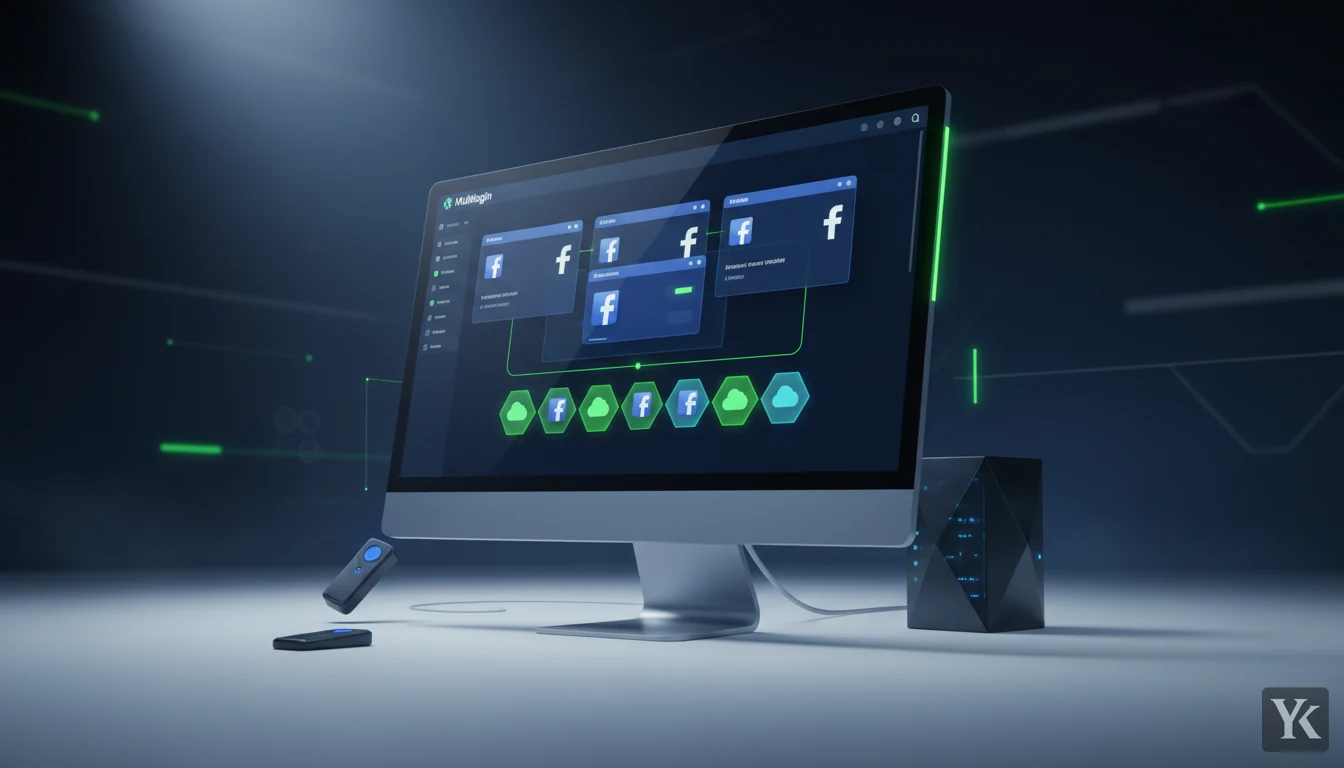
If you're managing multiple Facebook accounts, the answer is Multilogin. Not a password manager, not browser tabs, not incognito mode. Multilogin gives each Facebook login its own isolated environment, complete with a unique fingerprint, dedicated proxy, and separate cookie store. That's the only setup that works at scale in 2026 without triggering constant verification loops or mass bans.
The rest of this guide explains exactly how to build that setup.
Why One Browser Isn't Enough
Facebook doesn't just check your username and password. It tracks your device fingerprint, IP address, browser configuration, timezone, screen resolution, and behavioral patterns. Log into two accounts from the same browser, and Facebook sees them as connected. Do it from the same IP, and the link is even stronger.
This is why simple solutions fail. Incognito mode shares your IP. Password managers don't change your fingerprint. Even dedicated browser profiles in Chrome or Firefox share underlying system attributes that platforms can detect.
Separation has to happen at the environment level, not just at the login level. Each Facebook account needs its own device identity, its own IP, and its own isolated session, every single time.
What Multilogin Actually Does
Multilogin solves this with two core technologies: anti-detect browser profiles and cloud phones.
Think of browser profiles as fully isolated browser instances, each built around a unique fingerprint. Every parameter Facebook might check gets configured independently per profile: operating system, browser engine, timezone, language, screen resolution, WebRTC settings, and more. Assign a residential proxy to that profile and it looks like a completely different device in a completely different location.
Cloud phones are Android virtual devices running in the cloud. You control them from your desktop, but each one behaves like a separate physical smartphone. Install Facebook, TikTok, or Instagram on each virtual device, log in once, and that account stays tied to that device. No physical phone farm required.
Both live inside a unified dashboard. One workspace, dozens of accounts, zero cross-contamination.
Does It Actually Prevent Bans?
Mostly, yes. But with an important caveat: environment separation reduces risk, it doesn't eliminate it.
What it prevents is the most common ban trigger: platform detection that multiple accounts share a device or IP. When each Facebook login has its own fingerprint and residential proxy, Facebook has no technical signal linking them together. Each account looks like an independent user.
What it doesn't protect against is behavior-based detection. If you're running aggressive automation, sending mass DMs, or violating platform policies, a clean environment won't save you. Platforms have gotten better at behavioral analysis, and a perfectly isolated account that acts like a bot still gets flagged.
The Decipher Zone guide on Multilogin cloud phones puts it plainly: separation at the environment level is important, but it's a risk-reduction strategy, not a guarantee. Treat it as the foundation, not the ceiling.
Building Your Account Structure First
Before you create a single profile, plan your structure. This is where most setups go wrong. People jump straight into creating profiles, end up with a mess of unnamed environments, and then accidentally log into the wrong account from the wrong profile. That mistake alone can trigger a flag.
A clean structure looks like this:
- One profile per account. Never share a browser profile or cloud phone between two Facebook accounts.
- Naming conventions that scale. Something like
ClientA_FB_MainorUS_Facebook_01tells you immediately which account it is, which client it belongs to, and which platform it's for. - Folders by client or niche. Multilogin supports folders and tags. Use them. An agency with ten clients should have ten folders, each containing all the profiles for that client.
- Location consistency. If an account was created in the US, its profile should always use a US residential proxy and a US timezone. Jumping between countries is a red flag.
Getting this right before you scale saves enormous headaches. Operational errors, like opening the wrong profile or logging into Account B from Account A's environment, are among the most common causes of linked account flags.
Step-by-Step Setup
The practical workflow for getting a Facebook login running inside Multilogin.
Create a browser profile
- Open the Multilogin dashboard and create a new browser profile.
- Name it clearly (e.g.,
US_Facebook_01). - Set the target platform to Facebook.
- Assign a dedicated residential proxy. One proxy per profile, matched to the account's geographic region.
- Configure fingerprint settings: choose an operating system, browser engine, timezone, language, and screen resolution that match the proxy location. If the proxy is in New York, the timezone should be Eastern, the language should be English (US), and the device model should be something plausible for a US user.
- Save the profile and launch it.
Inside that profile, log into Facebook normally. The account is now tied to that environment. Every future session for that account happens inside this profile.
Set up a cloud phone for mobile accounts
For accounts that live primarily in mobile apps (Facebook, Instagram, TikTok):
- Create a new cloud phone in the Multilogin dashboard.
- Select Android 14 (or the version appropriate for the app).
- Choose a device model and brand that fits the account's target region.
- Set the location to match the account's expected geography.
- Install the relevant social media app on the virtual device.
- Log in as you would on a regular smartphone.
The cloud phone behaves like a physical Android device. The app sees a real device environment, not a desktop browser pretending to be mobile.
Connect your scheduling tools
Run Buffer, Later, Hootsuite, or whatever scheduling tool you use inside the relevant Multilogin profile. Don't schedule posts from your everyday browser and then manage the account from a Multilogin profile. Keep everything tied to one environment per account. All logins, all scheduling, all manual engagement (comments, DMs, reactions) should happen inside the same profile.
Platforms track session behavior. Consistent activity from one environment looks natural. Mixed activity from multiple environments looks suspicious.
Warming Up New Accounts
New accounts need a warm-up period before you run any heavy activity through them. Platforms are most suspicious of fresh accounts that immediately start posting at volume or running ads.
The warm-up process is straightforward but takes time:
- Browse the feed for a few days before posting.
- Like and comment on posts naturally.
- Fill out the profile completely (photo, bio, interests).
- Follow a handful of relevant pages.
- Spread account creation across several days if you're creating multiple accounts. Don't create ten Facebook accounts in one afternoon.
Use different email addresses and phone numbers for each account. Keep each profile's settings consistent with its supposed location from day one. These aren't optional steps. A 2026 Multilogin review tutorial covering practical setup walkthroughs treats warm-up as a non-negotiable part of the workflow, not an afterthought.
Team Access Without Sharing Passwords
Agencies have a specific problem: multiple people need access to multiple client accounts, but sharing raw passwords is a security and compliance nightmare. Someone leaves the team and you have no idea which accounts they can still access.
Multilogin handles this with role-based team features. You invite team members by email, assign them roles (viewer, manager), and grant access to specific folders or profiles. A contractor managing Client A's accounts sees Client A's folder. They don't see Client B's folder. They never need the actual Facebook password; they just launch the profile and they're logged in.
This also prevents the accidental cross-login problem. If a team member only has access to the profiles they're supposed to manage, they can't accidentally open the wrong account. The structure enforces discipline.
For a broader look at how proxy configuration fits into this kind of multi-account setup, Anti-Detect Browser Proxy Setup Guide covers the technical side in detail.
Automation: What's Safe, What Isn't
Multilogin supports automation integrations. You can pass profile IDs and folder IDs into scripts built with Node.js and Puppeteer, which lets developers plug Multilogin into existing automation workflows. The profiles handle the fingerprinting and isolation; your script just tells Multilogin which profile to launch.
But automation still has to mimic human behavior. A clean environment doesn't make aggressive automation safe. Use automation for low-risk, repetitive tasks: checking message inboxes, pulling basic analytics, scheduling posts through an integrated tool. Keep high-risk actions, bulk follows, mass DMs, rapid-fire posting, manual or heavily throttled.
The platforms run behavioral analysis in parallel with fingerprint detection. A perfectly isolated account that sends a high volume of DMs in a short period still looks like a bot.
If you're comparing Multilogin to other anti-detect browsers for this kind of work, GoLogin vs Octo vs Multilogin comparison breaks down where each tool actually wins.
Real-World Setups
Agency with ten clients. Each client gets a folder in Multilogin. Inside each folder: one browser profile per platform (Facebook, Instagram, LinkedIn), each with its own residential proxy. Team members are assigned to specific client folders. Scheduling tools run inside the relevant profiles. Manual engagement happens in the same environment.
Content creator with multiple niche pages. Uses cloud phones to run separate Facebook and Instagram accounts, each on its own Android virtual device with its own location. No physical device farm. No logging into multiple accounts on one phone.
E-commerce seller. Browser profiles for Facebook Ads Manager, each tied to a specific ad account. The setup mirrors what tutorial walkthroughs show: create a profile named something like US_FB_AdAccount_01, assign a US residential proxy, configure the fingerprint for a US device, open Facebook Ads Manager inside that profile. Each ad account stays isolated, reducing the risk of one flagged account pulling down the others.
Limitations Worth Knowing
Multilogin is not cheap. Pricing is tiered and scales with the number of profiles and team seats, so large agencies should review current plan details before committing.
It also doesn't make you immune to policy changes. Facebook and other platforms actively update their detection methods. What works today might need adjustment in six months. Staying current with Multilogin's documentation and community updates is part of the ongoing maintenance.
And ethical use matters. The legitimate use cases are clear: agencies managing client accounts, creators running multiple brands, advertisers keeping ad accounts separated. Using this infrastructure for spam, fraud, or coordinated inauthentic behavior is a different thing entirely, and no tool protects against platform action when the underlying behavior violates terms of service.
Quick-Reference Checklist
Before you go live with any new account setup:
- One browser profile or cloud phone per account. No exceptions.
- Dedicated residential proxy per profile, matched to the account's region.
- Profile name follows a clear convention (client, platform, account number).
- Accounts organized into folders by client or niche.
- Fingerprint settings (OS, timezone, language, resolution) match the proxy location.
- Warm-up completed before any heavy activity.
- Separate email and phone number per account.
- Team access configured via Multilogin roles, not shared passwords.
- Scheduling tools and manual engagement both run inside the same profile.
- Automation limited to low-risk tasks; high-risk actions handled manually.
For picking the right proxies to pair with these profiles, the Best Anti-Detect Browsers for Multi-Accounting guide covers proxy types and matching logic in depth.
Frequently Asked Questions
Can I manage multiple Facebook logins on one device?
Yes, but only if each login runs inside its own isolated environment. Using Multilogin browser profiles or cloud phones, each with a unique fingerprint and dedicated proxy, lets you run multiple Facebook accounts from one machine without them being linked. Running them in the same browser, even in separate tabs or incognito windows, is not safe.
What proxy type works best for Facebook accounts?
Residential proxies are the standard recommendation for Facebook. Datacenter proxies are easier to detect and more likely to trigger verification prompts. Mobile proxies offer the strongest trust signal but cost more. Match the proxy's geographic location to the account's supposed location and keep it consistent across all sessions for that account.
Does Multilogin work for Facebook Ads Manager?
Yes. The standard workflow is to create a browser profile, assign it a residential proxy, configure the fingerprint for the target region, and open Facebook Ads Manager inside that profile. Each ad account gets its own profile. This prevents one flagged or banned ad account from being linked to others you manage.
How many accounts can I manage with Multilogin?
The number of profiles available depends on your plan tier. Multilogin's pricing scales with profile count and team seats. Check current plan details on their site before deciding on a tier, especially if you're managing accounts across multiple clients or platforms.
Is this against Facebook's terms of service?
Running multiple accounts for different clients or brands is standard agency practice. Facebook's terms restrict coordinated inauthentic behavior and spam, not legitimate multi-account management. The tool itself is neutral. What matters is what you do with the accounts. Agencies managing client pages, creators running separate brand accounts, and advertisers keeping ad accounts isolated are all legitimate use cases.
The Desk Team
research & testing desk · yosefk.me
The research desk behind yosefk.me — tool deep-dives, pricing breakdowns, and side-by-side tests that back up Yosef's hands-on reviews. Every piece is edited and fact-checked before it ships.