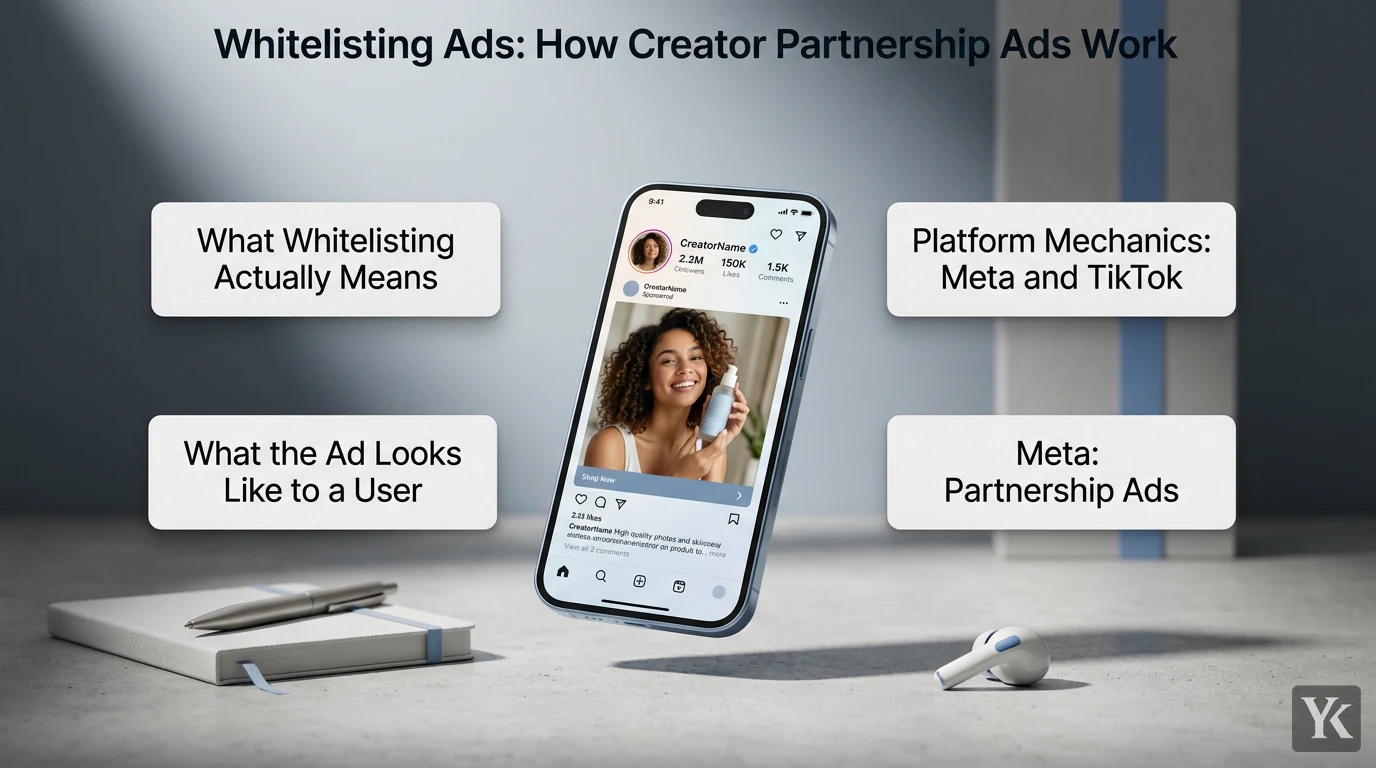
Most brands still treat influencer content as a one-time post. They pay for the content, it goes live, it gets a brief window of organic reach, and then it dies. Whitelisting ads flip that model, and advertisers have noticed: Meta's partnership ads now run at a $10 billion annual rate, double a year earlier (Forbes).
What Whitelisting Actually Means
The term gets used loosely, so let me be precise. As Influship's influencer whitelisting guide puts it: "Whitelisting is when a brand runs paid ads through a creator's social media account. The ad shows the creator's name and profile picture, but the brand controls the targeting, budget, and duration."
That single sentence contains the whole model. The creator's identity is the face of the ad. The brand's media buying infrastructure is the engine behind it.
But "whitelisting" is just one of several terms you'll hear, and they don't all mean the same thing. The Cirqle's 2025 guidance draws a clean distinction between three concepts that teams often conflate:
- Whitelisting (allowlisting): The brand gets permission to run paid ads directly from the creator's handle. The ad appears to come from the creator.
- Content licensing: The brand gets rights to use the creator's content, but runs it from the brand's own handle. The creator's identity doesn't appear.
- Dark boosts: Ad-only promotions that may never appear on the creator's organic feed. Followers can still see them if they fall inside the ad's targeting.
Understanding which model you're negotiating matters, because the fees, the disclosure requirements, and the performance implications are different for each.
Insense's explainer on Instagram whitelisting adds another layer: "Creator licensing is the formal process of getting permission to use a creator's content (and their handle) in your paid ads." In practice, most teams use "whitelisting" and "creator licensing" interchangeably when they mean running ads from the creator's handle, but the distinction matters in contracts.
What the Ad Looks Like to a User
When whitelisting is set up correctly, a user scrolling Instagram or TikTok sees an ad that shows the creator's name, profile photo, and existing post engagement. It doesn't look like a brand pushing a product. It looks like a creator they might follow recommending something.
The brand, meanwhile, controls every targeting parameter, the budget, the placements, and the optimization objective. None of that is visible to the user. The social proof is real (those likes and comments are from the creator's actual audience), but the distribution is entirely paid and performance-driven.
And that's why the format tends to outperform standard brand ads. More on the numbers in a moment.
Platform Mechanics: Meta and TikTok
The two platforms where whitelisting has the most mature infrastructure are Meta (Instagram and Facebook) and TikTok. The setup process differs meaningfully between them.
Meta: Partnership Ads
Meta's current product name for creator-run ads is partnership ads. The workflow runs through Instagram's native settings and Meta Ads Manager.
Meta calls the creator's side of this partnership ad permissions, and there are two kinds. Content-level: the creator opens a post, story or reel, taps Partnership label & ads, turns on Get partnership ad code, and sends you the code, which up to two partners can use (Instagram Help Center). Account-level: you send a permission request from Partnership Ads Hub and the creator approves it. You then enter the code, or pick the approved creator, when you build the ad in Ads Manager.
Partnership ads let you run the ad from the creator's identity while keeping all targeting, bidding, and optimization controls on the brand's side. The ad can promote a post that's already on the creator's feed, or run new creative from the creator's handle that never appears on their grid.
Meta has been pushing partnership ads aggressively, and the performance data backs up why. eMarketer's analysis notes that "partnership ads continue to outperform standard formats, delivering on average 19% lower CPAs and 13% higher click-through rates, according to Meta's own data." Check the baseline, though: Meta's page credits the 19% to adding partnership ads to business-as-usual campaigns, not to a head-to-head against brand ads. Forbes, reporting on an Agentio analysis of $130 million in spend across 65,000 ads from 137 brands, found that ads carrying the creator's handle earned about 19% more clicks, converted 10% better, and cost 5% less per customer than traditional licensed UGC run from the brand's account. Agentio sells creator-ad software, so read it as vendor data.
That last comparison is important. The benchmark isn't just "creator ads vs. generic brand ads." Even compared to brand-handle ads using creator content (content licensing), the creator-handle format won on clicks, conversion rate and CPA. Not on everything, though: the same report found partnership ads paid a 19% higher CPM (Net Influencer).
TikTok: Spark Ads and Content Suite
TikTok's equivalent is the Spark Ads format (covered in depth in the Spark Ads guide), and the authorization infrastructure runs through TikTok Content Suite.
Content Suite lets brands discover creator content, then send authorization invitations at either the video level or the account level. Video-level authorization is typically valid for up to 365 days. Account-level authorization stays active until the creator turns it off in their settings. TikTok's own documentation on brand collaboration through Content Suite walks through both invitation types.
On the creator side, the process involves toggling commercial content disclosures directly in the TikTok app. Creators choose whether a post is promoting their own brand or branded content, tag the brand partner, and enable ad authorization. When a creator generates a code, they pick the authorization duration: 7, 30, 60 or 365 days (TikTok Ads help). Creators can turn authorization off, but only for videos that aren't currently running as paid ads. A live Spark Ad has to be stopped by the advertiser or run out its window first.
The disclosure piece is not optional. TikTok's Branded Content Policy says creators must turn on the commercial content disclosure toggle for any branded content. Restricted categories such as alcohol and dating apps are shown only in the market they were posted in and may be age-restricted, and alcohol branded content isn't allowed at all in markets including Saudi Arabia, the UAE, Egypt, Kuwait and Qatar. Getting this wrong doesn't just create a compliance problem, it can kill the ad during review.
Compliance and Documentation
Neither platform checks your contract for you. The code or permission request is only the technical grant. For restricted categories such as alcohol, TikTok's policy requires the brand to get explicit approval from TikTok and work with creators only through TikTok One.
Get a signed agreement with the creator in place before you launch. It should specify which posts can be used, on which handles, and for how long. A verbal arrangement or a DM thread is not enough.
Pricing: What Whitelisting Costs
This is where a lot of brand-creator negotiations break down, usually because neither side comes in with a clear framework.
Standard Fee Structures
Whitelisting rights are typically priced as a percentage add-on to the creator's base content fee. The Influencer Marketing Hub's Spark Ads and whitelisting permission addendum provides one of the cleaner contractual frameworks in circulation: 25% of the deliverable fee per 30-day window, rising to 30% when the campaign runs concurrently on both Instagram and Facebook.
That addendum also specifies the license terms directly: "The creator grants a non-exclusive, non-transferable licence to run the listed post as an ad on the specified handle(s) for the chosen window. Rights expire automatically at 23:59 (local time) on day 30/60/90/365 unless renewed in writing."
The same guide calls a 25-30% surcharge per 30-day window the range procurement teams accept, so treat it as a starting point, not a rule. The addendum's windows run 30, 60, 90 or 365 days, with pre-pay discounts on 90, 180 and 365-day blocks.
| Window | Fee | Notes |
|---|---|---|
| 30 days | ~25% of base rate | Single platform |
| 30 days | ~30% of base rate | Instagram + Facebook simultaneously |
| 90 days, pre-paid | ~25% per 30 days, less 10% | Discount applies to usage fees only |
| 180 days, pre-paid | ~25% per 30 days, less 20% | Discount applies to usage fees only |
| 365 days, pre-paid | ~25% per 30 days, less 30% | Discount applies to usage fees only |
Negotiating the Terms
A few things worth getting explicit in any whitelisting agreement:
- Which handles: Account-level vs. video-level permissions have different implications. Account-level is more flexible for the brand but gives the creator less control.
- Geographic scope: If you're running campaigns in multiple markets, clarify whether the license covers all regions or specific ones.
- Exclusivity: Most whitelisting agreements are non-exclusive (the creator can work with other brands), but some categories warrant exclusivity clauses.
- Renewal terms: Define whether the brand gets right of first refusal to renew, and at what price.
- Withdrawal conditions: Creators should retain the ability to withdraw authorization if the brand's use becomes misaligned with their image. This protects both sides.
Get all of it in writing before the first dollar is spent, not after the campaign is already live.
Performance: The Numbers
Look, the lift from whitelisting ads is worth testing, but how big it looks depends on what you compare it against.
Meta's 19% lower CPA and 13% higher CTR, as reported by eMarketer, come from adding partnership ads to business-as-usual campaigns. Agentio's vendor data, reported by Forbes, is the tighter test: the same creator video run from the creator's handle versus the brand's handle alone. There the creator handle converted 10% better, but the CPA gap shrank to about 5%.
That last comparison is the one that matters most for teams already running creator content. You're not comparing against generic brand creative. You're comparing against creator content you already paid for, just served from a different handle. The delta is real, but it isn't uniform: in Agentio's data, partnership ads in Stories placements ran a 25% higher CPA despite an 11% CTR lift, and Roster's guide warns it is not a universal conversion lift. Test by placement.
Why the Handle Matters
When an ad appears from a creator's handle, it carries the creator's existing engagement, follower count, and perceived authenticity. The user's brain processes it differently than a brand ad. It reads as a recommendation, not a promotion.
There's also an algorithmic component. Content that already performed well organically, when amplified as a Spark Ad or partnership ad, benefits from that existing engagement signal. The platform has already validated that the content connects with some audience. Paid distribution extends that reach rather than starting from zero.
This is why Roster's guide on creator whitelisting emphasizes that brands retain full targeting, budget, and optimization control even when running through creator handles. The performance benefit comes from the creative identity, not from any loss of media buying control.
Running a Whitelisting Campaign: Step by Step
For Brands
- Select creators whose content and audience align with your campaign objective. Prioritize creators whose organic content already performs well in your category.
- Negotiate rights before content is created. Define the window, platforms, fee structure, and documentation requirements.
- Get the authorization set up. On Meta, the creator shares a partnership ad code for the post or approves your account-level partnership ad permission request. On TikTok, you send an authorization invitation through Content Suite (video-level or account-level).
- Connect authorization to Ads Manager. On Meta, link the authorization in your campaign setup. On TikTok, the authorized content becomes available for Spark Ads.
- Build variations. Test different copy overlays, CTAs, and audience segments using the same creator creative. The creative identity is fixed; everything else is testable.
- Set measurement before launch. Decide your primary KPI (CPL, CPA, ROAS), set your kill threshold for underperforming placements, and run a clean A/B test against your current best-performing brand-handle ad.
For Creators
The creator's responsibilities are more than just clicking "approve." On TikTok, you need to:
- Toggle commercial content disclosures in the app before the post goes live
- Choose "Branded content" (not "Your brand") when a third-party brand is paying
- Tag the brand partner correctly
- Pick the shortest authorization duration that covers the window in your agreement when you generate the code (7, 30, 60 or 365 days; there's no 90- or 180-day option)
- Know how to turn off authorization if you need to withdraw it
On Instagram, you either turn on Get partnership ad code under Partnership label & ads on the specific post and send the brand that code, or approve the brand's account-level permission request. Turning a code off later only stops new ads; ads already running on it keep going.
The creator's handle is their professional asset. Treating authorization as a one-click formality is a mistake. Know what you're approving, for how long, and with what restrictions.
Risks Worth Knowing
Whitelisting ads aren't without downsides. A few that come up consistently:
Creator reputation risk. If the creator gets into a controversy after you've launched a campaign, the ads are running from their handle. You need a clear process for pausing the ads quickly, because switching off authorization won't take down ads that are already live on either platform.
Audience fatigue. Running the same creator's content at high frequency against overlapping audiences will burn out the social proof faster than you'd expect. Set frequency caps and rotate creators.
Attribution complexity. TikTok switched off its legacy MMP integration on March 31, 2025; apps still on it lost event sharing and attribution, so anyone running Spark Ads to app installs needs their MMP on TikTok's SAN integration. The performance numbers are real, but you need the right attribution model in place to see them accurately. For web offers, tracker setup is covered in the free affiliate tracking software guide.
Policy changes. Both Meta and TikTok update their branded content policies regularly. Categories that ran without issue last year may now require additional disclosures or face restrictions. Build a compliance review into your campaign launch checklist.
Practical Scenarios
DTC Brand on Meta Partnership Ads
A direct-to-consumer brand running standard brand ads decides to test partnership ads alongside their existing campaigns. They select three creators whose content has already performed well in organic posts, negotiate 30-day whitelisting windows at 25% above the base content fee, and collect partnership ad codes from each creator.
They run identical audiences and budgets against their existing brand-handle creative. They don't borrow Meta's 19% as the target, because that figure came from adding partnership ads to existing campaigns. The closer benchmark is Agentio's head-to-head, about 5% lower CPA, so a CPA gain that holds and covers the usage fee counts as a win. The test runs for four weeks before any optimization decisions are made.
The variable is the ad handle and creative identity. Everything else is controlled.
TikTok Campaign via Content Suite
A brand discovers three high-performing creator videos through TikTok Content Suite that organically mention their product category. They send account-level authorization invitations to two creators and video-level invitations to the third (whose account they want less control over).
Once creators accept and toggle commercial content disclosures, the brand runs Spark Ads using those videos. The existing engagement on the videos (views, comments, shares from the organic post) carries over into the ad unit. The brand targets lookalike audiences built from their existing customer list.
The commercial content disclosure is visible to users. Don't treat that label as the whole job. For US audiences, the FTC says not to assume a platform's disclosure tool is good enough: add your own plain disclosure such as "ad" or "sponsored", put it in the video itself rather than only the caption, and write it in the same language as the ad (FTC Disclosures 101). The affiliate link disclaimer guide covers wording.
Starting in 30 Days
If you want to get whitelisting campaigns live within a month, the sequence matters.
Week 1: Audit your current creator relationships. Identify three to five creators whose content performs well organically and who you have an existing relationship with. Check whether any of their content has already been used in ads and whether rights were formally established.
Week 2: Negotiate whitelisting terms. Use the 25% per 30-day window framework as a starting point. Get signed agreements in place before requesting any authorizations.
Week 3: Set up authorizations. On Meta, collect partnership ad codes or approved account-level permissions. On TikTok, use Content Suite to send authorization invitations. Confirm that commercial content disclosures are correctly configured.
Week 4: Launch a controlled test. Run creator-handle ads against your current best-performing brand-handle creative using identical audiences and budgets. Set your measurement framework before the campaign goes live, not after.
The native ads affiliate marketing launch plan approach of building the measurement framework before spending a dollar applies equally here. If you can't measure the CPA delta cleanly, you can't prove the format is working.
Frequently Asked Questions
What is the difference between whitelisting and a branded content post?
A branded content post is an organic post where the creator discloses a paid partnership, labeled "Paid partnership with [Brand]" on Instagram. Whitelisting goes further: the brand gets permission to run that content as a paid ad, controlling targeting and budget, with the ad appearing from the creator's handle. The disclosure still applies, but the distribution is paid rather than organic.
Do creators lose control of their account when they whitelist a brand?
No. Whitelisting grants the brand permission to run specific posts as ads from the creator's handle, but the creator retains full ownership and control of their account. But switching permission off doesn't pull ads that are already live. On TikTok, ad authorization can only be turned off for videos that aren't actively running as paid ads. On Instagram, turning off a partnership ad code stops new ads being created with it, but active ads using that code keep running. Put a takedown clause in the contract that obliges the brand to pause. The license in the contract is typically non-exclusive and time-limited; TikTok account-level authorization, though, runs until the creator switches it off.
How long should a whitelisting window be?
Most campaigns use 30 to 90-day windows. Thirty days is standard for short campaign flights and aligns with the typical 25% fee add-on. Ninety days works for evergreen content or longer product launches. One-year windows are available but less common, usually reserved for hero content that's expected to perform over an extended period.
Is whitelisting worth the extra fee?
Meta reports 19% lower CPA and 13% higher CTR when partnership ads are added to business-as-usual campaigns; against the same creator content run from your own handle, Agentio's vendor data puts the CPA edge nearer 5%. Whether that covers the fee (around 25-30% of the content fee per 30-day window) depends on media spend: the more you put behind the post, the faster a few points of CPA pay for it. Test it with a controlled budget before scaling.
What happens if the creator posts something controversial while my ads are running?
Your ads are running from their handle, so their reputation affects your brand's visibility. Your contract should let the brand pause the ads and end the license immediately if the creator's conduct conflicts with brand values. Have a clear internal process for monitoring and responding quickly.
Digital Marketing Technologist
Yosef Kassabry is a media buyer with 11+ years in paid acquisition for Arabic-speaking audiences across MENA and the Gulf. He runs paid media through direct buys and affiliate networks, and writes about ad platforms, tracking, native ads and affiliate marketing for people who run campaigns.