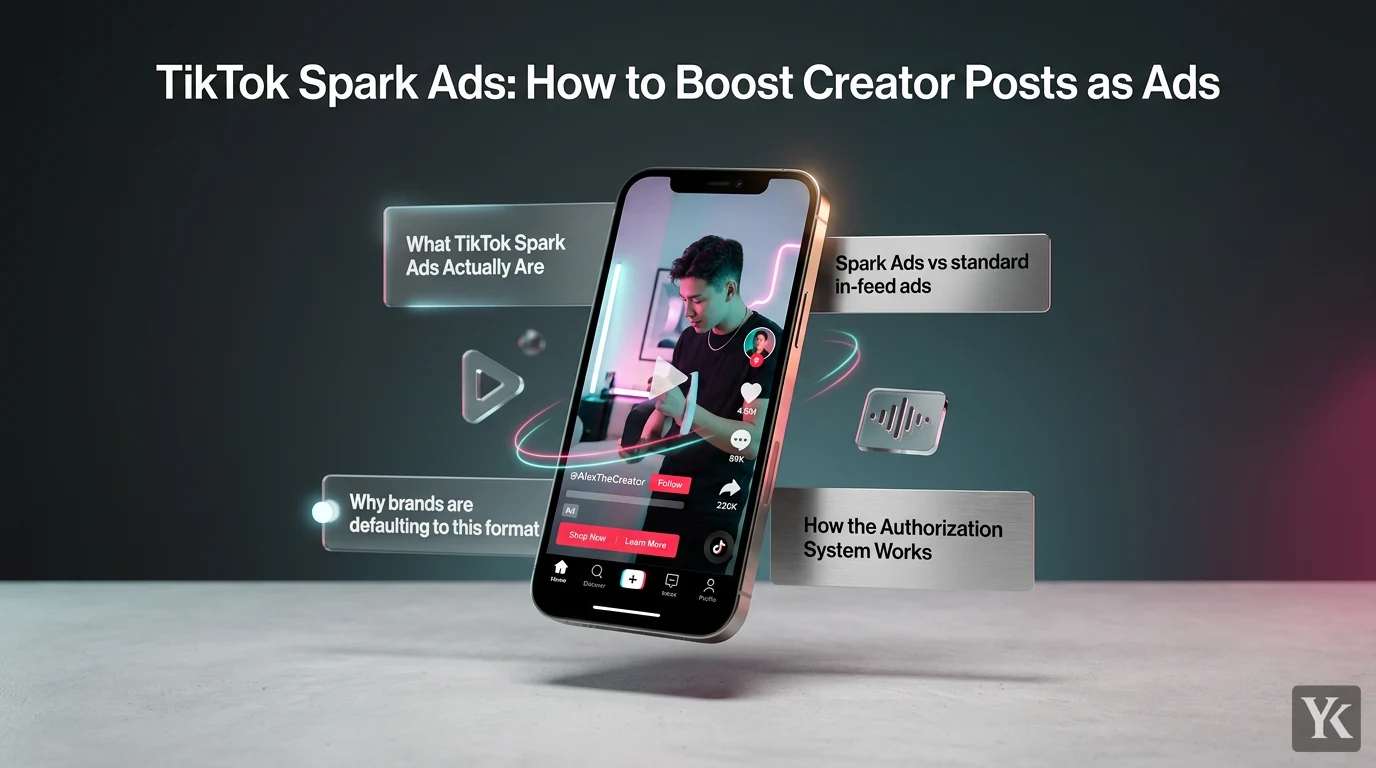
You've got a creator post pulling strong organic numbers. The real question is: why are you leaving that momentum on the table instead of putting spend behind it?
What TikTok Spark Ads Actually Are
As the TikTok Ads Help Center puts it, Spark Ads are "a native ad format that allows you to leverage organic TikTok posts and their features in your advertising." The post keeps its like count, comments, shares, and the creator's handle, all intact, while you put paid distribution behind it.
This is the difference from a standard in-feed ad. A standard ad runs under a brand display name, starts at zero social proof, and looks like an ad from the first frame. A Spark Ad runs from the original post, whether that's your own account or a creator's, and carries every engagement signal the video has already earned. The RockAds Spark Ads guide describes it simply: "TikTok's native ad format that allows advertisers to boost existing organic content, either from their own profile or from a creator's, as paid ads."
Spark Ads vs standard in-feed ads
| Feature | Spark Ads | Standard In-Feed Ads |
|---|---|---|
| Identity shown | Creator or brand handle | Brand display name only |
| Social proof | Carries existing likes, comments, shares | Starts at zero |
| Follower growth | Goes to original account | None (profile taps go to the landing page) |
| Content source | Existing organic post | New creative upload |
| Feel | Native, creator-style | Clearly an ad |
| Whitelisting | Supported via authorization codes | Not applicable |
Spark Ads feel like content, not ads. That distinction matters on TikTok more than on any other platform, where the entire culture is built around authentic, creator-native video.
Why brands are defaulting to this format
TikTok's own case for the format is on its Spark Ads in Video Shopping Ads page: +142% engagement rate, +43% CVR and 4% lower CPM versus non-Spark ads, though AdMake traces those figures to 2020–2021 internal data. For platform context, a 2026 benchmark report from Influee (Triple Whale data) puts overall TikTok CTR at 1.77% for 2025, up from 1.56% (Influee reads that as all click types; link CTR by industry runs 0.49–0.73%), while CVR fell 6.2%. More clicks, fewer buyers.
ROAS needs more caution. The same Triple Whale dataset puts the 2025 median ROAS for all TikTok ads (not just Spark) at 2.21, with apparel on top at 2.49, beauty at 0.74 and food and beverage at 0.49, and Influee reads the low figures as attribution gaps more than real losses. Vertical "Spark ROAS" tables that circulate without a named dataset aren't worth planning around.
How the Authorization System Works
Two paths to running a Spark Ad: using your own posts, or using a creator's post via an authorization code. The workflows are different.
Your own posts
If you want to promote content from your own TikTok account, the flow is straightforward. In Ads Manager, when you reach the ad creative step, select the "TikTok Posts" tab instead of uploading new creative. Pick the post, confirm the preview, and build the ad from there. No codes required, no creator coordination.
There's also a "push" option, where you upload a new video in Ads Manager and TikTok publishes it to your linked account as the ad's post. TikTok's help centre notes a pushed video stays off your profile by default: in Smart+ campaigns it goes up in private mode once it passes review, and in manual campaigns the Show through ads only box is on by default.
Creator posts via authorization codes
This is where the real power is for brands working with influencers or UGC creators. The process runs like this:
- The creator turns on ad authorization in their TikTok settings, then opens the video they want to whitelist, taps the three dots and switches on Ad authorization under Ad settings.
- They generate a Spark Ads authorization code for that post. The code is time-bound, typically tied to the duration you've agreed on.
- They share the code with you, usually via email or a brief.
- You go into TikTok Ads Manager, go to Creative Library > Spark Ad Posts, and redeem the code.
- Once confirmed, the post appears in your Spark Ads library and you can build campaigns around it.
TikTok's creation guide confirms you can batch-authorize up to 20 video codes at once, which makes it practical to test multiple creator posts in parallel without doing them one at a time. If you booked the creator through TikTok One (which replaced the old Creator Marketplace), you can request Spark authorization there and sync the posts straight to Ads Manager, no code swapping needed.
Creator whitelisting: rights, duration, and control
Spark Ads are TikTok's version of what Meta calls partnership ads. As the MediaGlitch Creator Whitelisting Guide explains, "creator whitelisting … lets you run ads from a creator handle using your ad account, your budget and your targeting." The creator's handle shows on the ad, but your targeting, bidding, and pixel are all running underneath.
Each authorization code is tied to a specific post and a specific time window. When the authorization expires, the ad stops running. Agree on duration before the campaign launches, not after, because renegotiating mid-flight is a mess.
Identity: creator handle vs brand handle
A Spark Ad always shows the handle of the account that published the post, and Ads Manager won't let you swap it. So the real choice is where the video lives: on the creator's account, or posted to your brand account. Running from the creator's handle means comments and any follower growth from the ad go to the creator's account, not yours. Running from your own brand account means you capture the follower lift, but lose the creator-native feel.
Creator-handle ads tend to outperform brand-handle ads in UGC-heavy categories because they look more like content and less like advertising. The trade-off is operational: you need a plan for who monitors and responds to comments on the creator's post when it's getting paid traffic.
What Does This Actually Cost?
Two separate cost lines to think about here.
Media spend
TikTok advertising cost data from Affroom puts Spark Ads CPCs in the $0.50 to $1.00 range and CPMs around $6 to $10. That's in line with other TikTok in-feed formats. No format premium for using Spark Ads on the media side.
Creator authorization fees
The creative cost is separate. As the AdMake AI Spark Ads guide notes, "The right to run paid spend from the creator's handle is a separate line item, priced in current UGC rate guides at roughly 30% of the base content fee per 30 days as a baseline." For high-performing posts or larger creators, that rate can run up to 100% of the base UGC fee per month.
So if you're paying a creator for a UGC video, expect to pay an additional authorization fee per 30-day period — typically a meaningful percentage on top of the base content cost, depending on the creator's size and how much demand there is for the post. Nail down the fee structure before you start, and build it into your campaign budget from day one, not as an afterthought.
Budgeting across multiple creators
A common pattern for DTC brands is to authorize three to five creator posts at launch, put modest spend behind each, and identify the one or two pulling the lowest CPL within the first week. Then concentrate spend there. Running one creator post with a large budget is riskier than running several at lower budgets and letting the data tell you where to scale.
Setting Up Spark Ads: Step-by-Step Workflow
The full workflow from account setup to live campaign.
Step 1: Prepare accounts and permissions
- Your TikTok business account must be linked to your Ads Manager.
- If you're running from a creator's handle, the creator needs to have ad authorization enabled in their TikTok account settings before they can generate codes.
- Have your TikTok Pixel installed and event mapping confirmed before you spend a dollar. Tracking set up after launch is tracking that's already missing data.
Step 2: Campaign and ad group settings
Create your campaign and choose your objective: awareness, consideration, or conversion. For DTC brands optimizing toward website purchases, that's the Sales objective (Website conversions on accounts that don't have the merged Sales objective yet). At the ad group level, set placements, budget, bidding, and your optimization event. The Spark switch lives one level down: at the ad level, under Identity, toggle on "Use TikTok account to deliver Spark Ads" (newer Ads Manager layouts just let you pick the post from the TikTok posts tab).
Step 3: Pull your own posts or push new content
At the ad creative step, select the TikTok Posts tab. You'll see existing posts from your linked account. Select the one you want to promote. Alternatively, use the Push option to upload a new video and publish it as a Spark-eligible post directly from Ads Manager.
Step 4: Redeem creator codes
Go to Creative Library > Spark Ad Posts and enter the authorization codes your creators have shared. To add up to 20 codes in one batch, use Add post on the TikTok posts tab while building the ad instead. Preview each post before confirming, and make sure the right handle is showing before you build the campaign.
Step 5: Ad-level settings and tracking
Set your destination URL and CTA button. You can't edit a pulled post's caption, display name or video, so any on-screen text has to already be in the creator's original. Attach your UTM parameters here and confirm pixel tracking (the optimization event itself, such as add to cart or purchase, is set at the ad group level). Then publish.
TikTok's own Spark Ads creation guide is the reference to keep open alongside Ads Manager; menu labels shift between account layouts, so trust it over third-party screenshots.
Does Creative Format Actually Matter?
Yes. More than most other variables.
Start by picking posts with proven organic traction, meaning high views, strong like-to-view ratios, and comment activity. A post that landed organically is already telling you the hook works and the audience responded. That's the signal you want to amplify, not guess at.
UGC formats that convert
The formats that consistently perform well as Spark Ads:
- Product demos and tutorials - show the product working, not just existing
- Testimonial and review videos - first-person, authentic, specific to results
- Transformation stories told, not shown - the creator explains the result in their own words; before-and-after comparisons aren't allowed in TikTok ads under the misleading content policy
- Unboxing - works especially well for beauty, food, and lifestyle
- Story-time formats - "I tried X for 30 days and here's what happened"
Translated advertorials and polished brand videos don't tend to perform as well in this format. The more it looks like an ad, the less it performs like a Spark Ad.
Balancing authenticity with a clear offer
The creator's natural voice needs to stay intact. Over-scripting or over-directing the content kills the thing that makes Spark Ads work. But authenticity alone doesn't drive conversions. The video still needs a clear hook in the first two seconds, a specific benefit or result mentioned in the body, and a reason to click at the end.
Landing page continuity matters more than most brands realize. If the creator post is about a specific product result, the landing page should lead with that result, not a generic homepage. Mismatched messaging between the ad and the landing page is one of the most common reasons Spark campaigns underperform on CVR even when CTR is strong.
Can You Scale Without Burning Out the Creative?
A lot of brands hit a wall here. A single creator post has a frequency ceiling. Once your target audience has seen it a few times, engagement drops and CPL climbs.
The answer is rotation. Authorize multiple posts across multiple creators, and rotate them on a schedule. A reasonable creative refresh cadence for a DTC brand running consistent Spark spend is new posts every three to four weeks. Build that into your creator agreements upfront, not as a scramble when performance dips.
On audience testing: run the same creator post against two or three different audience segments simultaneously. The post that clears your target ROAS against one audience can miss it badly against another. The creative isn't the only variable.
Native Ads Affiliate Marketing: 30-Day Launch Plan follows a similar logic for native campaigns: test the placement and audience before scaling spend, not after.
Reading the data correctly
CTR is not the number that matters. A creator post with a high CTR but a low CVR is worse than a post with a lower CTR and a stronger CVR. Optimize toward CPL and ROAS, not click-through rate.
Spark Ads also carry organic engagement signals that can inflate surface metrics. A video with a large comment count looks great in a dashboard, but those comments may have nothing to do with purchase intent. Track the full funnel: CTR, CVR, CPA, and ROAS per creator post. That's the signal set that drives actual decisions.
Common mistakes worth avoiding
- Promoting low-engagement posts or unlicensed sounds - if it didn't land organically, paid spend won't save it, and a trending commercial track the creator only licensed for personal use can get the ad rejected (AdMake)
- Ignoring comment management - when a creator's post gets paid traffic, comments multiply; someone needs to monitor them
- Letting authorization codes expire mid-campaign - set a calendar reminder for renewal at least a week before expiry
- Overpaying for whitelisting rights - 30% of base UGC fee per 30 days is a reasonable starting point; don't let that drift to 80-100% unless the post is genuinely exceptional
- Weak landing pages - the ad creative earns the click; the landing page earns the conversion
Marketing Automation Tools Under $100/Month can help automate the reporting side, so you're not manually pulling CPL by creator post from Ads Manager every day.
Performance Patterns by Vertical
Beauty and skincare brands are a natural fit for this format. UGC review videos and tutorial-style posts map directly to how people research beauty purchases on TikTok. Skip before-and-after results, though: TikTok's misleading content policy lists "Showing wrinkles disappearing by using a cream through before-and-after comparisons" as not allowed.
Food and beverage brands run taste-test and recipe content from creators as Spark Ads to drive both DTC and retail traffic. This content works best when the product is visual and the creator's reaction is genuine, but judge it on blended revenue: Triple Whale's 2025 median ROAS for all TikTok food and beverage ads is just 0.49, which Influee attributes largely to attribution gaps.
Fashion and lifestyle brands benefit most from running on creator handles rather than brand handles, because the social proof and community trust that comes with a creator's audience is part of what overcomes purchase hesitation. Apparel actually posts the highest median ROAS on TikTok in Triple Whale's 2025 data (2.49, all ad types), but sizing and fit concerns still don't resolve in a TikTok video, so the landing page has to do that work.
Health and supplements get the most scrutiny. TikTok's weight management policy restricts weight loss claims to 18+ audiences and bans claims that a product alone causes weight loss, and its misleading content policy bans before-and-after result comparisons. A transformation video that did well organically can still be rejected once you put spend behind it, so screen the post against policy before you ask for the code.
Frequently Asked Questions
What's the difference between a Spark Ad and a boosted post?
A Spark Ad runs through TikTok Ads Manager with full campaign controls: audience targeting, bidding strategies, pixel tracking, A/B testing, and optimization toward conversion events. Boosting a post is a simpler, more limited promotion with fewer targeting and optimization options. If you're running performance campaigns, Spark Ads through Ads Manager is the right tool.
Do you need a large following to run Spark Ads?
No. You can run Spark Ads from your own account regardless of follower count, as long as your TikTok business account is linked in Ads Manager. For creator-based Spark Ads, the creator's following matters for the authorization fee structure, but even micro-creators with engaged audiences can produce effective Spark content.
How long does a Spark Ads authorization code last?
The creator picks 7, 30, 60 or 365 days when generating the code for that post (TikTok Help Center), so agree the window before the campaign launches. A creator can extend an active authorization from the video's Ad settings, but an expired code can't be reactivated: they'd generate a new one and you'd relink the post (AdMake). When the authorization expires, the ad stops running. Build renewal into your campaign calendar.
Are Spark Ads available for all TikTok campaign objectives?
Under auction buying, TikTok lists Spark Ads for Reach, Traffic, Video Views, Community Interaction, App Promotion, Conversions, Lead Generation and Sales. Reach & Frequency buys are narrower: Reach, Traffic and Video Views only (TikTok Help Center).
What happens to comments when a Spark Ad runs from a creator's handle?
Comments appear on the creator's original post and accumulate there. The creator (and anyone they've given access to) can see and respond to them. Brands running creator-handle Spark Ads should establish upfront who monitors comments and how to handle questions about the product, because paid traffic will generate more comments than the organic post did on its own.
Implementation Checklist
Before launch:
- TikTok business account linked in Ads Manager
- TikTok Pixel installed and purchase event firing correctly
- Creator contracts signed with authorization duration and fee structure confirmed
- Spark Ads codes generated and redeemed in Creative Library
- Landing pages reviewed for message match with each creator post
- Kill thresholds set per ad: define the CPL ceiling before launch, not mid-campaign
During optimization:
- Track CPL and ROAS per creator post, not just aggregate campaign metrics
- Rotate creative before frequency-driven performance decay sets in
- Test audience segments independently from creative tests
- Monitor comments on creator posts actively, especially in the early hours of paid traffic
Governance:
- Authorization expiry dates in your calendar with a renewal reminder
- Brand safety clauses in creator agreements covering what happens if content becomes problematic
- Off-boarding process confirmed: what happens to the ad when rights expire
The MediaGlitch Creator Whitelisting Guide has a short contract checklist (usage term and renewal price, raw footage rights, exclusivity) worth copying if you're building a repeatable creator program rather than one-off campaigns.
Spark Ads work because paid distribution amplifies something that already proved itself organically. The format isn't magic, but it's genuinely better than starting from zero social proof every time. Get the tracking right before launch, set your kill thresholds before you spend, and let the CPL data tell you which creator posts deserve the budget. If you're running creator content on Meta too, Whitelisting Ads: How Creator Partnership Ads Work covers the same permission logic there.
Digital Marketing Technologist
Yosef Kassabry is a media buyer with 11+ years in paid acquisition for Arabic-speaking audiences across MENA and the Gulf. He runs paid media through direct buys and affiliate networks, and writes about ad platforms, tracking, native ads and affiliate marketing for people who run campaigns.