Most media buyers treating Telegram like a niche experiment are leaving real reach on the table. Telegram crossed one billion monthly active users, and its ad platform has matured from a rough beta into a structured CPM marketplace with multiple billing rails, geo-based pricing, and a growing ecosystem of third-party networks. If you're already running paid acquisition on Meta and Google, Telegram ads deserve a serious look, not because the targeting is comparable, but because the audience quality in certain verticals is genuinely hard to find elsewhere.
The Sponsored Messages Model
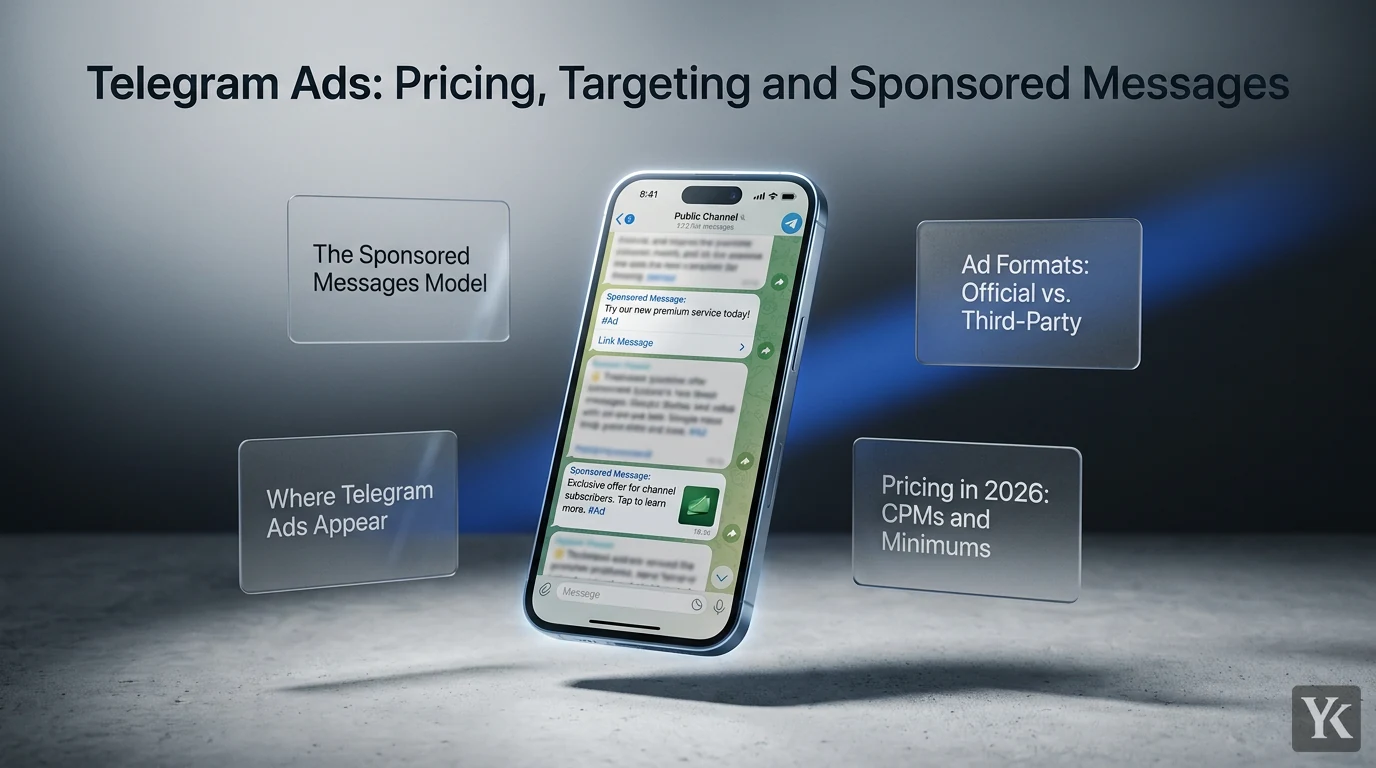
Telegram's official ad format is called sponsored messages. Short text placements, up to 160 characters, that appear at the bottom of posts in eligible public channels. They're labeled "AD" so users can see them, but they sit inside the feed rather than as a separate ad unit. Billing is CPM-based, meaning you pay per 1,000 impressions, not per click.
The platform lives at ads.telegram.org, and it's simpler than you'd expect from a company that runs a privacy-first messaging app. You pick a cabinet (more on that below), fund it, write your message, choose targeting, set a CPM bid, and launch. No lookalike audiences, no retargeting, and only basic conversion reporting. What you get is reach into specific channel categories and geographies.
As Telegram's own API documentation puts it, the platform added sponsored messages as "a paid privacy-friendly way to promote bots and channels." That framing matters. The ad system is designed around what Telegram is willing to expose, which is channel-level context, not individual user data.
Ad Formats: Official vs. Third-Party
The official sponsored message is up to 160 characters of text plus one button, and where that button can go depends on the account. Self-serve accounts funded in Gram (formerly TON) can only link to Telegram destinations: a channel, a post, a bot, or a mini-app. EUR accounts, sold through official partners, can also link to external websites and add a photo or video, but only in the markets Telegram has opened to them: partner lists include the UAE, Saudi Arabia, and Egypt, not the US. That split shapes how you build the funnel.
Third-party networks like RichAds and PropellerAds operate differently. They sell ad slots inside Telegram mini-apps and bots, mostly clicker and casual games, in formats the native platform doesn't offer: push-style ads, interstitials, video ads, playable ads, and bot ads. These formats can link externally. RichAds' 2026 pricing guide lists push-style ads from $0.015 per click, interstitial ads from $1.5 CPM, video and playable ads from $3 CPM, ads in bots from $3.8 CPM, and embedded banners from $0.4 CPM.
The distinction matters for funnel design. Official sponsored messages work best when you're driving users into a Telegram-native experience. EUR accounts or third-party networks are the route when you need external landing pages or more creative flexibility.
Where Telegram Ads Appear
Sponsored messages show in public channels with at least 1,000 subscribers, and Telegram Premium subscribers don't see them at all, so that audience is out of reach on the official platform. Channel owners get 50% of the ad revenue from impressions served in their channel. That revenue share gives owners a reason to grow past the 1,000-subscriber threshold, which keeps the inventory pool expanding.
Some bot dialogues also serve sponsored messages. Beyond that, placement is determined by your targeting: specific channels, bots, and search keywords on a Gram account, with topics, languages, and geos added on an EUR account.
Pricing in 2026: CPMs and Minimums
Here is the thing about Telegram's pricing: the floor is low, but what you actually pay depends heavily on niche and geography.
Official CPM Model and Minimums
The Telegram Ad Platform getting started guide states the minimum CPM for sponsored messages is 0.1 Toncoin. Toncoin was renamed Gram on June 15, 2026, and at mid-September 2026 prices (about $1.30 per Gram) that floor works out to roughly $0.13 per 1,000 impressions. The dollar value moves with the token, so check the rate before you budget. For Euro-based accounts, a 2025 pricing overview puts the floor at €1 CPM for most niches and €0.50 CPM for the politics niche specifically.
Those floors are just floors. Real clearing prices run higher in competitive niches. Adsly's 2026 benchmarks put crypto at $2-$5 CPM, finance and forex at $3-$6, and news and media at $0.50-$1.50. The gap reflects advertiser demand for high-intent audiences, the same dynamic you see on any mature ad platform.
Budget Requirements and Deposits
The cabinet you choose determines your entry cost.
- Gram (formerly TON) account: Agency guides put the first deposit at about 20 Gram, roughly $26 at September 2026 prices. It's crypto-native and cheap to test, but it can only link to Telegram destinations and targets by channel, bot, or search keyword.
- EUR accounts: Direct access to Telegram has long required a €2 million commitment, so most advertisers buy EUR accounts through official partners and resellers. Entry deposits vary by agency, from roughly €250–€500 to €3,000–€5,000.
- Stars: Channel and bot owners can move Stars they've earned into their ad account, and Telegram adds a 30% discount when they do.
The EUR cabinet's deposit requirement is the biggest barrier for smaller advertisers. This is where resellers come in. Agencies and resellers buy bulk inventory and resell access at lower minimums, which is how most smaller teams get started without a seven-figure commitment.
Geo-Based CPM Tiers
The Telegram Ads cost calculator shows a clear pricing hierarchy by geography:
| Geo Tier | Countries | Typical CPM |
|---|---|---|
| Tier 1 | US, UK, DE, FR | $10-12 |
| Tier 2 | Eastern Europe, MENA, LatAm | $3-5 |
| Emerging | Uzbekistan, India, much of LatAm | $0.30-0.60 |
For teams running in MENA, don't plan off the emerging-market band. The same calculator puts MENA in Tier 2 at $3-5, and PropellerAds' Q1 2025 benchmarks show Arabic-speaking countries clearing around 1.5 TON per 1,000 impressions, about €2.60-€3.00 at the time. The 0.1 Gram floor is the same everywhere; what you actually pay in Arabic-language channels is set by the auction.
Third-Party Network Pricing
A UK casino offer (LeoVegas) run through RichAds' mini-app ads between February 27 and March 23, 2025 got 2.8 million impressions and 196,000 clicks on a $0.025 CPC bid and $1,800 in total spend. That produced 129 registrations at about $14 each, according to the RichAds case study. Gambling offers like this can't run on Telegram's official platform.
Look past the CPA: 196,000 clicks turned into 129 registrations, a click-to-registration rate under 0.1%. Mini-app traffic comes mostly from tap-to-earn and clicker games, so judge it on registrations and downstream revenue, never on clicks.
PropellerAds reported 18,000+ conversions for a tap-to-earn Telegram mini-app in a September-October 2024 case study, mostly from Nigeria, on CPA bids of $0.03-$0.05. The advertiser didn't disclose ROI, so read it as a volume result, not proof of profit. Both cases point to the same thing: Telegram traffic can convert, but you need to build the funnel to match how users actually behave on the platform.
Targeting Options
This is where Telegram Ads diverge most sharply from Meta and Google. There are no lookalikes, no demographic targeting, and no retargeting, and Telegram doesn't use private chats or contact lists for targeting. What you can target depends on the account: Gram-funded accounts place ads by channel, bot, and search keyword, while EUR accounts add a Target Users mode that reaches people by country, city, app language, device, and the topics of channels they follow.
Official Targeting: Topics, Language, Geo, Channels
What EUR accounts can target through ads.telegram.org (Gram accounts get specific channels, bots, and search keywords only):
- Topic categories: Finance, technology, crypto, sports, entertainment, news, etc.
- Language: Ads appear in channels matching the selected language.
- Location and device: Country and city, plus iOS, Android, desktop, or mobile.
- Specific channel lists: You can add individual channels by username to target their audiences directly.
That last option is the most powerful one on the native platform. If you know which channels your target audience follows, you can build a precise list and bid specifically for impressions in those channels. The trade-off is that narrow targeting raises your effective CPM as you compete for limited inventory.
What Telegram Does NOT Allow
No retargeting and no automated conversion optimization. The Statistics tab does count channel joins and bot starts after a view, and Telegram's Pixel Tag, added in 2025, reports website conversions for ads that link out, but only as reporting: bids aren't optimized toward those events.
If you want to measure what happens after someone taps your sponsored message, you're doing it through UTM parameters, bot analytics, or mini-app events tracked separately. Attribution is manual and imperfect. That's a real limitation for performance marketers used to Meta's attribution model. But it also means less competition from advertisers who won't run without full-funnel tracking, which keeps CPMs lower than they'd otherwise be.
Advanced Targeting via Ad Networks
Mini-app ad networks offer targeting Telegram's own ads don't, because they sell inventory inside mini-apps rather than Telegram's sponsored slots. Mobidea's overview of Telegram ad platforms notes that networks can now segment by device type, operating system, whether the user is a Telegram Premium subscriber, and even TON wallet balance. That last signal is particularly useful for crypto and Web3 offers where wallet holders are the actual target audience.
If you need that kind of segmentation on a small budget, a Gram account won't get you there. Mini-app networks will.
Setting Up a Campaign: Step by Step
Choose Your Cabinet
Log into ads.telegram.org with your Telegram account. You'll choose between a Gram account (crypto funding, lower entry, Telegram-only destinations), an EUR account (fiat, bought through official partners and resellers), or Stars (if you own a channel or bot that earned them). For most advertisers testing for the first time, the Gram account is the lower-risk starting point. For larger teams with established budgets, the EUR cabinet is more practical.
Fund the Account and Set CPM Bids
Add Gram through a crypto wallet or EUR via bank transfer, depending on your account. Set your CPM bid above the minimum floor. In competitive niches or Tier 1 geos, bidding at the floor means minimal delivery. In emerging markets with lower competition, the floor bid can deliver real volume.
A reasonable test scenario: fund a Gram account with about 20 Gram, add a short list of relevant channels in your target language (Gram accounts can't target by country or topic), set a competitive CPM bid above the minimum floor, and run for two weeks to collect impression and click data before making any decisions.
Write Effective Sponsored Messages
160 characters. That's it. You need a clear value proposition, a reason to tap, and a destination. On a Gram account the destination must be a Telegram bot, channel, or mini-app; external URLs need an EUR account.
What works:
- Lead with the benefit, not the product name
- Say what the reader gets instead of telling them what to do: Telegram sets the button label itself, and partner guides warn that moderators decline imperative calls like "Subscribe" or "Buy" and questions aimed at the reader
- Match the tone of the channels you're targeting, a crypto channel audience reads differently than a news channel audience
What doesn't: vague promotional copy that could apply to anything. Telegram users are in reading mode, not browsing mode. They're in a channel for a reason. Your message needs to be relevant to that context or it gets ignored.
Select Channels, Topics, and Locations
Start broader than you think you need to. Narrow targeting in a market with limited inventory can starve your campaign of impressions before you have enough data to make decisions. On an EUR account, pick 2-3 topic categories, select your target countries, add a language filter, and let it run. On a Gram account, which can't target by topic or country, build your channel list in your target language instead. Once you have data, narrow to what performed, and test a specific channel list as its own ad: Telegram doesn't let one ad mix user targeting with channel targeting.
Don't Chase CTR
Stop chasing CTR on Telegram. Seriously. A high CTR on a sponsored message means nothing if the users who tap don't complete the action inside the bot or channel. The metric that matters is cost per conversion, whether that's a channel subscription, a bot interaction, a mini-app registration, or whatever action sits at the bottom of your funnel. Set your kill threshold for cost per conversion before you launch, not mid-campaign when emotions are running high.
EUR accounts let you set a daily views limit per user, so you control frequency directly. Whatever account you use, plan fresh creative rotation if a campaign runs for more than a few weeks.
Telegram Ads vs. Meta and Google
| Factor | Telegram Ads | Meta Ads | Google Ads |
|---|---|---|---|
| Targeting depth | Low (topic/geo/language) | Very high (interest, behavior, lookalike) | High (keyword, intent, audience) |
| CPM range | $0.30-$12+ | $5-$30+ (varies widely) | Varies by format |
| Attribution | Basic (joins, bot starts, Pixel Tag reporting) | Full pixel attribution | Full conversion tracking |
| Ad formats | Text, image, push, video (via networks) | Image, video, carousel, stories | Search, display, video, shopping |
| External links | EUR accounts and mini-app networks | Yes | Yes |
| Privacy model | No user-level data | Extensive user data | Intent-based |
Telegram's strength is niche community depth. Finance, crypto, tech, and B2B audiences on Telegram are highly engaged and often hard to reach efficiently on Meta. The platform has less ad clutter than any major social network, which means your message isn't competing with five other ads in the same scroll.
The weakness is measurement. If you can't operate without pixel-based attribution, Telegram is a frustrating place to run performance campaigns. The comparison from Adsly frames it well: Telegram isn't a replacement for Meta or Google, it's a complement for specific verticals and audience segments. Use it where it fits, not everywhere.
What Works in 2026
Budgeting and Bidding
Test with a Gram account first if you're new to the platform. The roughly 20 Gram entry point lets you validate channel placements and messaging before committing to an EUR account deposit. Once you have CPM and click data, you can calculate a realistic cost per conversion estimate and decide whether the EUR cabinet's wider targeting and website links justify the larger deposit.
For Tier 1 geos, budget for $10-12 CPMs and work backward from your acceptable cost per conversion. For emerging markets, the math is more forgiving, but conversion rates from those audiences need to justify the traffic quality.
Offers That Actually Work
Telegram Ads work best when the destination is Telegram-native. Sending users to a bot that delivers immediate value (a tool, a report, a signal) converts better than sending them to a channel they have to evaluate. Mini-apps are increasingly effective because they provide an app-like experience without leaving Telegram.
Verticals with documented traction: crypto and DeFi, fintech, news and media, B2B SaaS targeting tech-savvy audiences, and compliant finance offers (Telegram bans get-rich-quick and guaranteed-return promotions). The Native Ads Affiliate Marketing launch plan covers the broader affiliate angle, but Telegram specifically rewards offers where the value is obvious in 160 characters or less.
Cross-Channel Funnel Integration
Use Telegram Ads for top-of-funnel discovery into a bot or channel, then convert inside Telegram over time. Users who join your channel or start your bot can be re-engaged through organic posts. That's where the "no retargeting" limitation becomes less painful: you're building an owned audience inside Telegram, not relying on the ad platform to bring them back.
For external conversion goals, use UTM parameters on your bot links and track completions server-side. It's more work than a Meta pixel setup, but it's workable. Teams running multi-channel campaigns often use Telegram as the discovery layer and Meta or Google for conversion, but only visitors who actually reach your website can be retargeted there: users who stay inside a bot or channel never load your pixel. Pick a tracker that carries the click ID end to end before you launch; the free affiliate tracking software guide compares the options.
Risks, Policies and Compliance
Content Policies and Disallowed Categories
Telegram restricts certain categories from sponsored messages. The lower €0.50 floor for the politics niche is a price tier, not a green light: Telegram's Ad Policies and Guidelines prohibit ads promoting political campaigns, parties, candidates, or movements. The same rules ban adult content and dating services, gambling and betting, payday loans, get-rich-quick and guaranteed-return offers, and unverified supplements. You also need to comply with local advertising laws in every country you target, which for MENA campaigns means being aware of country-specific restrictions on financial products and certain types of offers.
Telegram's moderators review both the ad text and the destination. The guidelines ban ALL-CAPS, gimmicky emoji, line breaks, and bullet lists in the text, and a promoted channel needs a profile photo, a full description, and a post from the last two weeks. Keep creative straightforward and avoid anything that could be read as a guarantee of financial returns.
Fraud Prevention
Telegram uses impression-based billing, so you're charged for impressions served, not clicks generated. Telegram's creator terms let it withhold channel owners' rewards for invalid activity, but that protects Telegram, not your budget. Watch your impression-to-click ratio yourself. Abnormally high impressions with near-zero clicks can indicate placement in channels where your ad is technically served but the audience is disengaged or mismatched.
Working with Resellers Safely
If you want EUR billing, website links, or the Target Users mode, official partners and resellers are the realistic route, and the usual affiliate scam red flags apply when you choose one. The real question is what kind of reporting access you actually get. Do they give you campaign-level dashboard access, or are they just sending you a summary spreadsheet? Can you see impressions, clicks, and spend broken out by placement? Transparent resellers who give you dashboard access are worth the slightly higher CPM markup. Ones who only share aggregated reports are a problem, because you can't improve what you can't see.
Frequently Asked Questions
How much does it cost to start Telegram Ads?
The entry point depends on which cabinet you use. The crypto-funded account takes a first deposit of about 20 Gram (formerly TON), roughly $26 at September 2026 prices. EUR accounts are sold through official partners and resellers, with entry deposits from a few hundred to several thousand euros; direct access to Telegram has long required a €2 million commitment.
Can I link to an external website from Telegram sponsored messages?
Only from an EUR account. Self-serve accounts funded in Gram (formerly TON) can only link to Telegram channels, posts, bots, or mini-apps. EUR accounts, sold through official Telegram ad partners and resellers, accept website links with UTM tags. Mini-app ad networks like RichAds and PropellerAds are the other route to an external landing page.
How does Telegram Ads targeting work?
EUR accounts target by country, city, language, device, topic, and channel audiences; Gram accounts target by channel, bot, and search keyword. Neither offers demographics, lookalike audiences, or retargeting. Third-party networks offer more granular options including device type, OS, Telegram Premium status, and TON wallet balance.
What CPM should I expect for Telegram Ads?
It depends on niche and geography. Tier 1 geos (US, UK, Germany, France) typically run $10-12 CPM. Tier 2 regions run $3-5 CPM. Emerging markets can be as low as $0.30-0.60 CPM. Niche matters too: Adsly's 2026 benchmarks put crypto at $2-$5 CPM and finance at $3-$6, while news and media channels run $0.50-$1.50.
Is Telegram Ads worth it compared to Meta or Google?
For most verticals, it's a complement, not a replacement. Telegram is worth testing if your target audience is active in crypto, fintech, tech, or B2B communities; if you're comfortable with limited attribution; and if you're building a Telegram-native funnel (bot or channel) rather than driving cold traffic to a landing page. The Newage.Agency guide on Telegram advertising covers the tradeoffs in detail for teams evaluating it as a primary channel.
Who Should Run Telegram Ads in 2026
Honest answer: not everyone. If your funnel depends on pixel-based attribution and you can't operate without it, Telegram's official platform will frustrate you. If you're in a vertical where Telegram communities are genuinely active, specifically crypto, fintech, tech tools, news, or Arabic-language media in MENA, the combination of mid-range CPMs and high-intent niche audiences makes it worth a structured test.
Start with a Gram account. Pick one language and a short list of relevant channels. Write three message variants. Set a kill threshold for cost per conversion before you launch, not after. Run for two weeks, look at cost per bot start or channel join, and decide from data. That's the minimum viable test. Anything less and you're not actually testing Telegram ads, you're just spending money on them.
Digital Marketing Technologist
Yosef Kassabry is a media buyer with 11+ years in paid acquisition for Arabic-speaking audiences across MENA and the Gulf. He runs paid media through direct buys and affiliate networks, and writes about ad platforms, tracking, native ads and affiliate marketing for people who run campaigns.