An AI marketing agent is a system built around a language model that works toward a marketing goal over several steps, calls tools to get there and decides for itself what to do next. Plenty of ad tools now sell something they call an agent. Some are chatbots with a new label, some are fixed workflows with a model doing one step, and others are real agents that read your account, choose their next step and act. The difference matters once one of them can reach an ad account with a card attached.
This is an explainer, not a tool list: what an AI marketing agent is, how to tell it from a chatbot or a workflow, where it connects to an ad account, and which paid-media work to hand off, supervise or keep human. The working example is the AI writing pipeline this site runs on.
What an AI Marketing Agent Is: Model, Tools, Loop and Guardrails
In Building effective agents, Anthropic describes agents as "systems where LLMs dynamically direct their own processes and tool usage," and in practice "typically just LLMs using tools based on environmental feedback in a loop."
Every agent has four parts:
- Model. The language model that reads the situation and picks the next step.
- Tools. What it can call: pull a report, fetch search terms, write a draft, change a budget. OpenAI's practical guide to building agents separates data tools, which retrieve information, from action tools, which change something. In an ad account, that's the line between reading a report and editing a campaign.
- Loop. Call a tool, read the result, decide, repeat, until the task is done, something fails or a turn limit is hit.
- Guardrails. Which tools it may call, what needs approval, what it may spend and when it must stop. OpenAI's guide lists instructions, "explicit guidelines and guardrails defining how the agent behaves," as a core component, and suggests rating each tool's risk on "read-only vs. write access, reversibility, required account permissions, and financial impact."
Instructions can sit in a system prompt or in packaged instructions loaded when a task matches, which is how Claude Skills work.
OpenAI's tool risk rating is the sorting this article applies to paid media, and Anthropic's post explains why it matters: "The autonomous nature of agents means higher costs, and the potential for compounding errors."
Agent, Chatbot or Workflow: How to Tell Which One You Are Buying
A product sold as an agent can be any of three things, and the label won't tell you which.
| Chatbot | Workflow | Agent | |
|---|---|---|---|
| Who picks the next step | You | Whoever designed the flow | The model |
| Can it change the account | No | Only in its fixed steps | Anything its tools allow |
| Typical risk | A confident wrong answer | A broken step nobody notices | Errors that compound |
A chatbot answers questions, and according to OpenAI's guide, "simple chatbots, single-turn LLMs, or sentiment classifiers" are not agents, because the model doesn't control how the work gets done.
A workflow runs a fixed path: in Anthropic's terms, "systems where LLMs and tools are orchestrated through predefined code paths." A model may score a lead or write a subject line at one step, but the possible paths are set in advance. Some of what is sold as AI agents for workflow automation is exactly this, a flow built in a tool like n8n with a model call in the middle. That's not a criticism: the routing in an automated lead generation workflow is deterministic on purpose.
An agent picks its own next step and tools, which makes it useful for open-ended jobs and riskier for the same reason.
The quickest test: who decides what happens next? A flowchart means a workflow; the model means an agent. The simplest solution, as Anthropic puts it, "might mean not building agentic systems at all," and for a lot of paid-media plumbing a boring workflow is the right answer.
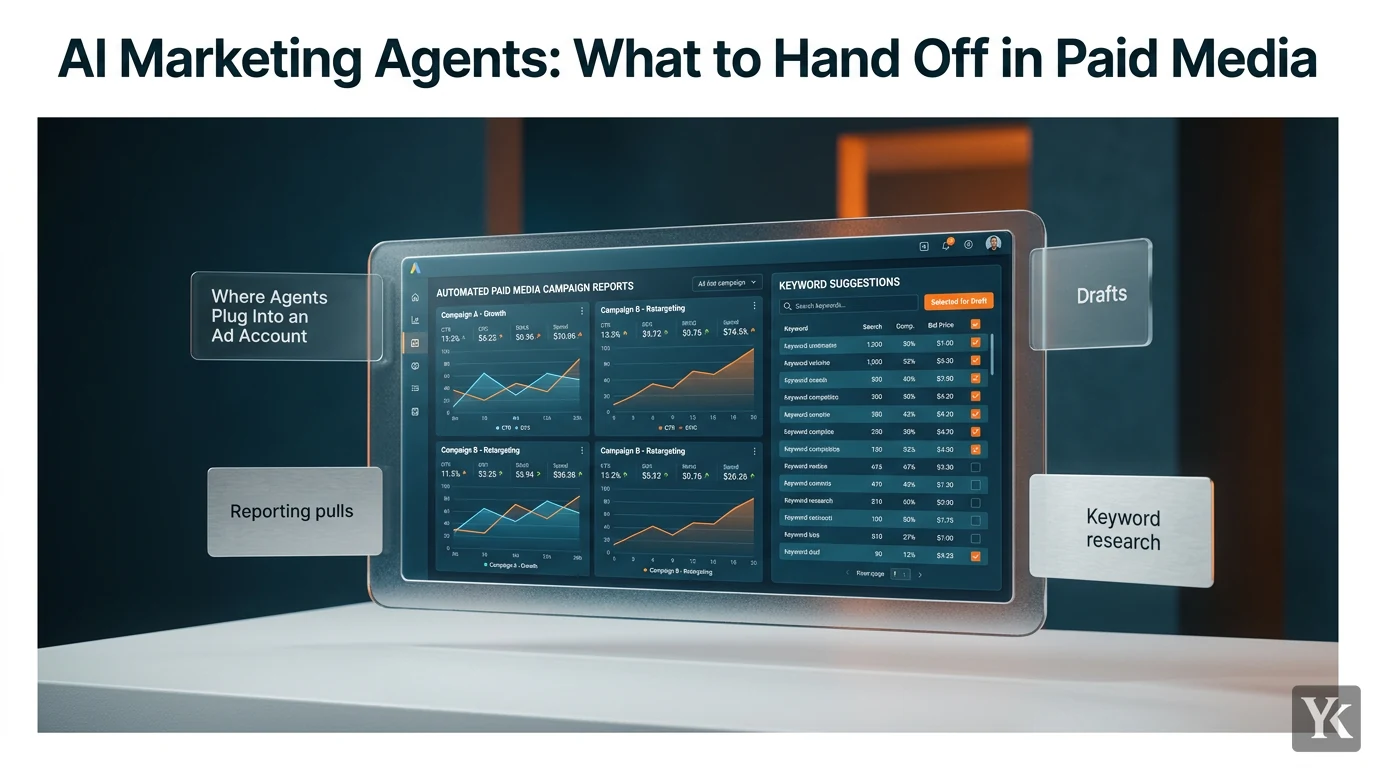
Where Agents Plug Into an Ad Account
There are three ways an agent-like system reaches an ad account, and they differ mainly in who controls the permissions.
- Platform-native automation. The platform's own AI: automated bidding, budget distribution, generated creative. It optimizes toward whatever conversion signal you feed it. You don't grant it access; you steer it with bid strategy, budgets, conversion goals and the automated features you switch on.
- Official API and MCP connectors. The platform's API, or an MCP server built on it. MCP (Model Context Protocol) is an open standard for connecting AI models to external tools and data. The access you grant when you connect matters most: reporting access and write access to budgets are very different grants. Meta's ads MCP server is one such connector, and it can edit campaigns as well as report on them.
- Third-party agent tools. Products that connect to one or more platforms through their APIs and add cross-platform reports, suggested changes and approval queues. They hold credentials to your accounts, so their security becomes part of yours.
Whichever route, the questions are the same: what can it read, what can it change, and who approves each change?
Safe to Hand Off: Reporting Pulls, Drafts, Keyword Research and Tracking QA
My sorting rule: work is safe to hand off when the agent only reads, or when its output is a draft a human reviews before anything touches the account. A mistake there costs time, not money.
Reporting pulls
The first job I would give any agent is the daily pull: spend, conversions, cost per lead, CPA and ROAS by campaign, with changes called out. It needs read access and nothing more. Google Ads, for example, has a Read-only access level that can view campaigns and run performance reports but can't edit campaigns.
Two instructions make the report worth reading. Lead with cost per lead, not click-through rate, because a cheap click is worthless if the audience never converts. And tie every line to a decision, since a dashboard that drives no decision is decoration. If kill rules were set before launch, the report should say which campaigns are near them.
Drafts
Ad copy variants and headlines arrive as drafts, which makes them good agent work. The guardrail is the source material: the agent writes from an approved list of claims, offers and brand terms and never invents a benefit to lift CTR.
Keyword research
Expanding seed lists, grouping keywords by intent and flagging irrelevant search terms as negatives is read-and-suggest work. A human decides what goes live, especially brand, competitor and ambiguous terms.
UTM and tracking QA
Tracking goes in before the first dollar is spent, and checking it is tedious, which makes it ideal agent work. The readiness checklist in this site's Google Ads tracking template guide is a ready-made spec for Google Ads: {lpurl} in the template, HTTPS across the redirect chain, and utm_source, utm_campaign and gclid reaching the CRM. The agent reports what's broken; a human fixes it.
Supervised: Bid and Budget Suggestions the Agent Proposes and You Apply
In the middle tier, the agent proposes and a human applies: lower this target CPA, shift budget between campaigns within the agreed total, pause a placement whose cost per lead is past the kill line.
Three conditions make it work:
- Rules come first. Kill thresholds and scaling rules are set before launch, not argued about mid-campaign. For a placement, I'd start with a kill threshold around 20% above the average cost per lead, which leaves room to optimize. The agent reports when a rule is hit. It doesn't invent new ones.
- Every suggestion shows its work: the data behind it, the expected effect and how to undo it.
- Small samples don't count. Set a minimum conversion volume before any suggestion can fire.
Why not let it apply its own suggestions once they look good? Because the risk is the rare wrong one, applied at machine speed. OpenAI's guide takes the same line: actions that are "sensitive, irreversible, or have high stakes" should trigger human oversight "until confidence in the agent's reliability grows," and one of its examples is making payments. A budget change is a payment decision.
A human on the apply step also keeps the agent from fighting the platform's own automated bidding over the same campaigns: one owner for budget changes, one timestamped change log.
Human Only: Spend Changes, Account Structure and Policy-Sensitive Ads
The rule is simple: whoever is accountable for the money presses the button.
Spend changes
A budget edit is bigger than it looks. Google's help page on average daily budgets says that for most campaigns a single day's spend can reach twice the average daily budget, and its page on spending limits puts the monthly limit at 30.4 times the average daily budget. An agent that types $500 instead of $50 hasn't set a $500 ceiling: that campaign can now spend up to $1,000 in a day. Anything that raises total spend stays human, and so does switching bid strategies.
Account structure and measurement
Campaign structure, conversion goals, attribution settings and the definition of a qualified lead stay human. Changes here can reset learning and break reporting, and an agent optimizing toward duplicated or misconfigured conversions will scale the wrong outcome. It can audit the setup, not redesign it.
Policy-sensitive ads
Anything regulated or sensitive gets a human sign-off before it runs: financial, health, housing, employment, political and social-issue ads, testimonials and comparative claims. Meta, for instance, requires advertisers to declare a Special Ad Category for ads about financial products and services, employment, housing, or social issues, elections or politics, and warns that ads may be rejected if the right category isn't chosen. The exact rules vary by country. In my view, most ad rejections come from policy terms and images rather than the copy, and neither should be left to a model.
The three tiers at a glance
| Task | Tier | The human's role |
|---|---|---|
| Reporting, drafts, keyword research, tracking QA | Hand off | Reviews the output and decides |
| Bid and budget suggestions, pauses under kill rules | Supervised | Applies or rejects each change |
| Budget increases, bid strategy switches, account structure, policy-sensitive ads | Human only | Owns the decision |
A Working Example: The Guardrails in This Site's Own AI Pipeline
This blog runs on a CMS and AI writing pipeline I built. An AI writer drafts articles, and an AI assistant can research, edit and queue them for publishing through a set of tools. It isn't an ad account, but the problem is the same: a system that can act, spend money and publish under my name. The rules I run it by carry over to paid media almost one for one.
- Drafts land in a pending-approval queue, not on the site, the way an agent's budget suggestions should.
- The AI has no publish-now command. It can queue an article for a future time, and the scheduler re-runs its validation when that time comes and refuses anything that fails.
- Paid tools sit behind a budget guard. Every tool that costs money checks a monthly budget first and refuses to run once it's reached.
- Every edit the AI makes saves a revision first, so any change can be traced and rolled back. That matters most for live posts, where an edit goes out with the next site rebuild.
- Every draft is fact-checked before publishing. A drafting model can't tell a true fact from a plausible one, so load-bearing claims are checked against primary sources first. The full policy is on the page about how articles on this site are made.
The lesson that transfers: limits are enforced by the system, not requested of the model. A tool labeled read-only is making a claim, and the MCP specification says clients must treat tool annotations as untrusted unless they come from trusted servers. A queue, a budget check and a validation step hold whatever the model decides.
Campaigns in Other Languages: Where Agent Copy Needs a Native Reviewer
For campaigns in another language, localization beats translation: copy has to be written for the market, not converted into its language. That is a reason to be cautious about agent-written copy in other languages. Arabic, a language with many regional dialects, is a well-studied example.
The AraDiCE benchmark, presented at COLING 2025, notes that Arabic remains significantly underrepresented in large language models, particularly in its dialects, and found that "significant challenges persist in dialect identification, generation, and translation," even though Arabic-specific models did better than multilingual ones on dialect tasks. A preprint published in April 2026 built a dialogue benchmark covering 13 Arabic-speaking countries, in Modern Standard Arabic (MSA) and each country's dialect. On all three of its tasks, models did worse in dialect than in MSA.
In practice:
- Fine to hand off: report summaries in another language, first drafts in a language's standard written form, keyword lists a native speaker will prune.
- Needs a native reviewer from the target market: anything in a regional dialect, plus humor, slang and religious or seasonal references such as holiday messaging.
- Never ship: an ad or advertorial translated from another language and pushed live unchanged. An agent just makes that old mistake faster.
Localization matters too much in a campaign in another language to hand it to the part of the stack that is weakest at it.
Questions to Ask Before You Connect an Agent to an Ad Account
People ask which AI agent is best for marketing. Without your account in front of it, that question has no answer. These questions do, and a vendor that can't answer them clearly has ruled itself out.
- What scopes does it request? Reporting, campaign edits, billing? Grant the smallest set that does the job.
- Is reading separated from writing? Can you grant read access alone and add write access later?
- What stops it spending? A hard cap enforced by the platform or the tool, not a line in a prompt. The daily budget isn't the daily ceiling.
- Is there an audit log? Every action, what triggered it and when, exportable. The MCP specification lists logging tool usage for audit purposes among its security considerations.
- Can you undo it? What is the rollback for each type of change, and who performs it?
- Is there an approval queue? Which actions wait for a human, which run straight away, and can you move one to the other list?
- Where are the limits enforced? By the platform or server, or only by a label? Ask to see a blocked action fail.
- Who pays for a mistake? Read the terms for what happens when the agent makes a change you didn't want.
Then run it read-only before it gets any write access. My rule of thumb, not a platform requirement: at least two full weeks, so its reports and suggestions cover two complete weekly cycles, checked against what you would have done. After that, widen its access one task at a time, starting from the hand-off tier.
Frequently Asked Questions
What is an AI marketing agent?
A system built around a language model that works toward a marketing goal over several steps, calls tools such as reporting APIs or ad platform connectors, and decides its own next step. It has four parts: a model, tools, a loop, and guardrails that limit what it can touch.
What is the difference between an AI agent and a workflow?
A workflow follows a fixed path someone designed, even when a model handles one step. An agent chooses its own next step and tools. Workflows are more predictable, so a lot of marketing automation should stay a workflow.
Should an AI agent be allowed to change ad budgets?
Not on its own. Let it propose reallocations with evidence and an undo path for a person to apply, and keep spend increases a human decision. In Google Ads, a single day's spend can reach twice the average daily budget for most campaigns.
Which AI agent is best for marketing?
It depends on your accounts, so this article doesn't rank tools. Judge candidates on requested scopes, read/write separation, hard spend caps, an audit log, undo and an approval queue, then run your pick read-only for at least two full weeks.
Will AI agents for marketing replace media buyers?
Not the part that matters. Agents read, draft and check at volume. The offer, the kill rules, the budget and the definition of a qualified lead are still the media buyer's call, and copy in another language still needs a native reviewer from the market it targets.
Hand Off the Legwork, Keep the Money Decisions
The useful question isn't whether to use AI marketing agents but what each one may touch. Hand off the reading and drafting, supervise the suggestions, and keep spend, structure and policy calls with a person who answers for them. Enforce the limits in the system rather than the prompt, start read-only, and widen access one task at a time.
Digital Marketing Technologist
Yosef Kassabry is a media buyer and full-stack developer with 11+ years in paid acquisition for Arabic-speaking audiences across MENA and the Gulf, and more than $10M in managed ad spend. He runs paid media through direct buys and affiliate networks, builds his own tools, and writes about ad platforms, tracking, native ads and affiliate marketing.