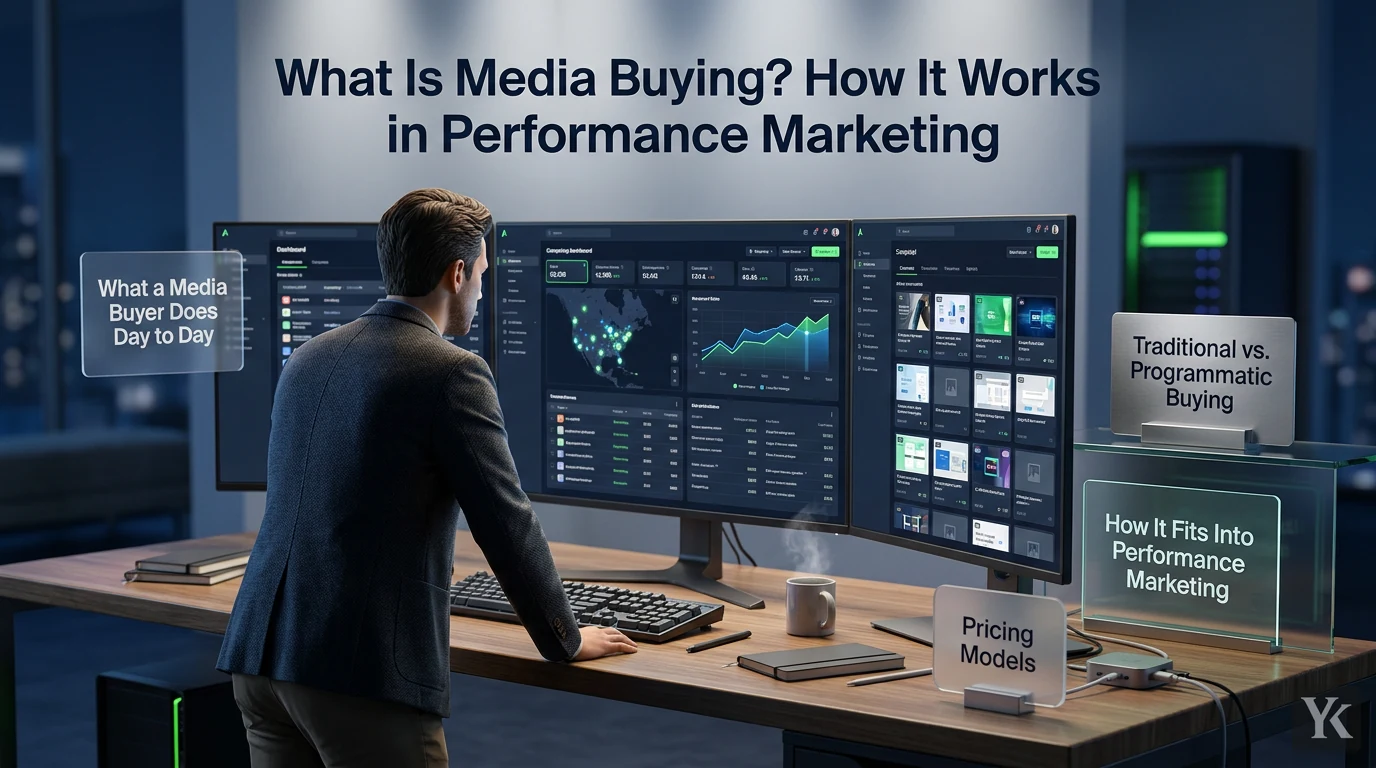
Media buying is the work of purchasing ad placements, on self-serve platforms like Meta and Google, directly from publishers, or through native, affiliate and programmatic networks, and then managing that spend until it pays back. In performance marketing the job is judged on one number: what each lead, sale or install costs against what it is worth. A cheap click is worthless if the audience never converts. I have been a media buyer at IDI Ventures since 2014, working through direct media buys and affiliate networks for Arabic-speaking audiences across MENA and the Gulf, and this is how the work actually runs.
What Is Media Buying?
Media buying covers the purchase and management of advertising placements across paid channels. Inventory can include search results, social feeds, websites, apps, video, connected TV, retail platforms, digital out-of-home, audio, and creator environments.
Media planning determines where and why to advertise: which channels reach the target audience, what the competitive space looks like, how much budget each channel deserves. Media buying executes that plan: it secures the inventory, negotiates or bids for placements, manages delivery, and optimizes against performance targets. In practice, one person often handles both, but the functions are different and confusing them leads to weak strategy.
What a Media Buyer Does Day to Day
On a performance team, the buyer's week is mostly a loop of checking, cutting and launching:
- Check delivery and tracking first. Is spend pacing to budget, and are conversions still being recorded? A broken pixel looks exactly like a bad campaign.
- Compare platform numbers with the tracker or CRM. Platforms count conversions their own way; the business counts paid orders and qualified leads.
- Cut what crossed its kill rule. Placements, ad sets or publishers whose cost per lead ran past the threshold agreed before launch get paused, not debated.
- Launch new tests. Fresh creatives, new angles, new publishers or audiences, each with a capped budget.
- Shift budget toward what pays back, gradually, so the platform's learning isn't reset every few days.
- Report. In my case that means ROAS, CPA and CTR for Arabic-language campaigns across MENA and the Gulf. CTR goes in the report, but I judge a traffic source on cost per lead, not CTR.
How It Fits Into Performance Marketing
Performance marketing is the model where advertisers spend against measurable business outcomes rather than exposure alone. Media buying is the engine of that model, but it doesn't run by itself.
Every performance campaign connects several moving parts: the ad placement, the conversion tracking that records what happens after the click, the landing page that converts visitors, the creative that earns the click, the offer that makes the conversion worth something, and the attribution model that assigns credit across touchpoints. Pull any one of those out and the whole system degrades.
Common performance goals include completed purchases, qualified leads, app installs, subscriptions, and revenue. The goal isn't impressions or even clicks; it's a downstream business event that can be tied to margin.
Traditional vs. Programmatic Buying
The old model was direct negotiation. A buyer contacts a publisher, agrees on a placement, a rate, and a run period, and the ad appears. That model still exists for premium sponsorships, niche audiences, and guaranteed reach where auction dynamics would be unfavorable or too unpredictable.
The dominant model now is auction-based. Programmatic advertising grew 20.5% year over year to $162.4 billion in the U.S. in 2025, according to IAB. Total U.S. digital advertising revenue approached $300 billion in the same year, up 13.9% year over year.
Programmatic is an execution method, not a synonym for digital advertising: a direct buy can run on a digital publisher, and a programmatic campaign can run on connected TV.
Pricing Models
The pricing model sets what you pay for, and so who carries the risk: on CPM you pay whether or not anyone clicks, on CPA the seller only gets paid when a conversion happens.
| Model | What You Pay For | Typical Use Case |
|---|---|---|
| CPM | A set number of impressions | Awareness, reach, video |
| CPC | Each click | Search, traffic campaigns |
| CPA | Each conversion | Performance, lead gen |
| CPL | Each lead | B2B, service businesses |
| CPV | Each video view | YouTube, video campaigns |
| Flat fee | A fixed placement for a set period | Direct buys, newsletters, sponsorships |
ROAS is not a pricing model. It is the scorecard every one of these models answers to. The CPM formula walks through the math from CPM to CPA, and how CPA marketing works covers per-conversion offers and payouts.
Where Performance Media Gets Bought
Most performance budgets flow through five kinds of seller:
- Self-serve ad platforms. Meta, Google, TikTok, Snapchat and similar. The buyer sets budgets, bids and audiences; the platform's auction and delivery algorithm decide who sees the ad.
- Direct publisher buys. A negotiated placement, rate and run period with one site, app, newsletter or channel. They suit audiences concentrated in a few properties.
- Native ad networks. Taboola, MGID and regional networks such as Jubna place sponsored content in publishers' recommendation widgets, usually priced per click. Native ads for affiliate offers lays out a 30-day launch plan.
- Programmatic exchanges. A demand-side platform bids on individual impressions across many publishers in real time (explained below).
- Affiliate and CPA networks. Instead of paying for placements up front, the advertiser pays partners per conversion, and the network tracks the action and handles payouts.
I work hands-on in Google Ads and Meta Ads and have funded native campaigns on Jubna, Taboola and MGID, where CPCs ranged from about $0.03 to $0.40 depending on publisher mix. That spread is the lesson: the same budget buys a very different number of clicks depending on which publishers it lands on, so the publisher list matters as much as the bid.
The Buying Process: Start to Finish
1. Define the Goal and Conversion Event
Pick one primary optimization event before you touch a platform. A completed purchase, a qualified lead form submission, a subscription start. Document the conversion definition, its value, your acceptable acquisition cost, and any margin constraints. If you can't define what success looks like before launch, you'll be arguing about it when the campaign is live and money is moving.
2. Establish Unit Economics
The numbers that matter before you set a budget:
- CPM = (Ad spend / Impressions) x 1,000
- CPC = Ad spend / Clicks
- Conversion rate = Conversions / Clicks
- CPA = Ad spend / Conversions
- ROAS = Revenue / Ad spend
Your allowable CPA should reflect contribution margin, average order value, customer lifetime value, and retention, not just revenue. A campaign can show strong ROAS and still be unprofitable if margins are thin and fulfillment costs are ignored.
3. Choose Channels and Inventory
Channel selection follows audience behavior and funnel stage. Search captures existing intent: the person is already looking for what you sell. Social supports discovery and demand creation: you're interrupting someone who wasn't actively searching. Retail media reaches shoppers near the point of purchase. Display and programmatic provide reach and retargeting at scale, video and connected TV carry upper-funnel reach, and digital out-of-home adds location and time signals.
4. Build the Audience Strategy
First-party audiences, built from your own customer data, are the highest-value starting point. Platform audiences, lookalikes, contextual targeting, and remarketing layers build out from there.
Segment by funnel stage. Someone who abandoned a checkout needs a different message than someone who has never heard of your brand. Exclusions matter too: excluding existing customers from acquisition campaigns and excluding converted leads from lead-gen campaigns prevents wasted spend and inflated frequency. Audience overlap between ad sets causes internal competition and drives up your own costs.
5. Creative and Landing Pages
The ad earns the click. The landing page earns the conversion. Both have to work, and media buying cannot compensate for either one being weak.
Check mobile speed, message match between the ad and the page, tracking implementation, and lead-form quality. A slow mobile landing page can sink a campaign that the creative and targeting got right. If the ad promises a specific offer and the landing page doesn't reflect it, conversion rate drops and you pay for traffic that was never going to convert.
6. Tracking, Attribution, and Data Quality
Set up tracking before the first dollar is spent. Always. On Google Ads that starts with auto-tagging and a tracking template that passes campaign and click data through to the landing page or tracker. Pixels or tags, server-side or enhanced conversion signals where available, UTM parameters, CRM feedback loops, offline conversions, deduplication, and consent requirements all need to be in place before launch.
Platform-reported attribution is not the same as incremental business impact. Every platform attributes as much credit to itself as its model allows. Compare platform data against your analytics, CRM, and, where possible, incrementality tests. If you run Meta campaigns, Meta Conversions API covers the server-side setup, deduplication and event match quality.
7. Bid, Budget, and Buying Method
Daily budgets keep spend roughly even but are not hard daily caps: Google Ads can spend up to twice the average daily budget on a given day and up to 30.4 times it in a month, and Meta also lets some days run over and balances the week. Lifetime budgets give the algorithm flexibility to pace toward performance peaks. Neither is universally better; the right choice depends on campaign length and how much control you want over day-to-day delivery.
Automated bidding strategies work when you have enough conversion data for the algorithm to learn from. Without sufficient signal, they chase noise. Manual controls let you cap bids but require more active management. Frequency management matters in display and social: an audience that sees the same creative twenty times isn't more likely to convert. They're more likely to develop negative associations with your brand.
How Programmatic Auctions Work
When a user loads a page or opens an app, an impression opportunity is created. Supply-side technology makes that opportunity available to buyers. Eligible buyers evaluate the impression against their targeting criteria and bid. An exchange or platform conducts a real-time auction, the winning bid's ad is served, and performance data is recorded. The entire process takes milliseconds.
The participants in that chain: the advertiser wants to reach an audience. The demand-side platform (DSP) manages the advertiser's bids across multiple exchanges. The supply-side platform (SSP) manages publisher inventory and sends it to exchanges. The ad exchange connects buyers and sellers. The publisher provides the inventory. Data providers layer in audience signals. Retail media networks are a variation where the retailer is both publisher and data provider.
Programmatic buying has expanded well beyond web display. It now covers connected TV, digital audio, and programmatic digital out-of-home, where location and time signals can trigger automated outdoor ad purchases. WARC's 2025 programmatic report forecast that connected TV and retail media will lead ad spend growth through 2026, and found that half of digital out-of-home campaigns were already bought fully or partly programmatically.
AI and Automation in Media Buying
AI-assisted campaign management is consolidating targeting, bidding, creative inputs, budget allocation, and attribution into unified campaign products. Google's Performance Max is the clearest example: one campaign type accesses Search, YouTube, Display, Discover, Gmail, and Maps simultaneously, with Google's systems automating bidding and placement decisions based on advertiser-provided goals, budgets, and creative assets.
In April 2025 Google announced channel-performance reporting for Performance Max, which breaks results out across Search, YouTube, Display, Discover, Gmail, Maps and Search partners. That's a meaningful improvement because the previous opacity made it difficult to diagnose underperformance or reallocate budget intelligently.
Automation improves scale and can find efficiencies a human buyer would miss. But it requires strong conversion data to work against, creative assets that don't fatigue quickly, brand safety controls, and independent measurement to validate what the platform reports. When conversion data is thin or the target event is poorly defined, automated systems chase whatever signal they can find, which may not be the signal you want. Control and transparency are the price you pay for scale.
Metrics That Actually Matter
Organize metrics by level and resist the temptation to collapse everything into one number.
Delivery metrics: Impressions, reach, frequency, viewability, CPM. These tell you whether the campaign is running as planned and whether the audience is seeing it.
Engagement metrics: Clicks, CTR, CPC, video completion rate, landing-page views. These tell you whether the creative is working. CTR alone tells you almost nothing about whether the campaign is profitable.
Conversion metrics: Conversion rate, CPA, CPL, CAC, revenue, ROAS. These are the numbers that determine whether the campaign is worth running.
Business metrics: Qualified pipeline, payback period, contribution margin, retention rate, lifetime value. These are the numbers that determine whether the business is growing. A campaign can hit its ROAS target and still be damaging the business if it's acquiring customers with poor retention or high service costs.
Optimization Framework
Separate diagnosis from action: confirm that tracking and delivery are working before you change anything. Then evaluate in this order: audience, creative, placement, bid, budget, landing page.
Creative testing: Test one major variable at a time where the platform allows it. Track performance by concept, format, audience, placement, and funnel stage. A practical test matrix:
| Variable | Options to Test |
|---|---|
| Creative angle | Problem-led vs. benefit-led vs. social proof |
| Offer | Discount vs. free trial vs. guarantee |
| Format | Static vs. video vs. carousel |
| Call to action | "Get started" vs. "See pricing" vs. "Book a demo" |
| Landing page | Long-form vs. short-form vs. quiz |
Budget allocation and scaling: Scale gradually. Doubling a budget overnight disrupts the algorithm's learning period and often causes CPA to spike. Protect an experimentation budget instead of moving everything toward whatever performed best in the last seven days. Short-term platform results are noisy, and attribution windows mean some conversions haven't been recorded yet. Reallocate only after accounting for conversion lag and statistical uncertainty.
Example Channel Mixes
These are illustrative workflows, not claimed results.
An e-commerce brand might use Search to capture high-intent demand from people already searching for the product category, run short-form social video for prospecting to cold audiences, retarget video viewers who engaged but didn't convert, and measure completed purchases through conversion tracking.
A B2B company might run paid search and paid social toward qualified CRM pipeline stages rather than raw lead volume, using offline conversion imports to feed actual sales outcomes back into the platform's bidding algorithm.
Creator inventory belongs in the mix too: IAB puts creator advertising spend at $37 billion in 2025. Whitelisting Ads: How Creator Partnership Ads Work covers how creator-handle campaigns run on Meta and TikTok.
Media Buying for Arabic-Speaking Markets
Buying for audiences across the Gulf and the wider MENA region adds a few rules that general guides skip.
- Localize, don't translate. Copy written for the market beats copy converted into Arabic. A translated advertorial pushed into a Gulf audience unchanged reads as foreign.
- Count cash on delivery, VAT and returns. Cash on delivery is still common in parts of the region, so a platform-reported purchase is not yet revenue. Refused deliveries, refunds and VAT all shrink real ROAS. How to calculate ROAS after VAT, refunds and COD returns works through the math.
- Move fast on news. Part of my work is trend-driven: turning breaking news into live creative within days. That only works when the creative approval path is as short as the news cycle.
- Use regional inventory. Arabic-language publishers and regional native networks can reach audiences that global networks cover thinly. I built an Arabic-language publisher network across the Gulf and MENA at DSNR Media Group from 2011 to 2013. The buying-side rule: know who owns the audience before you bid on it.
Common Mistakes
- Optimizing for clicks or CTR instead of cost per lead or cost per acquisition
- Launching without reliable conversion tracking in place
- Spreading a small budget across too many channels simultaneously
- Changing campaigns too frequently before the algorithm has enough data to learn
- Relying on last-click attribution for channels that operate earlier in the funnel
- Ignoring creative fatigue and running the same assets for months
- Failing to exclude existing customers from acquisition campaigns
- Accepting platform-reported results without any independent validation
- Neglecting brand safety and inventory quality in programmatic campaigns
- Defining the kill threshold after launch instead of before it
On that last point: set a placement-level kill threshold before the campaign goes live. My rule of thumb is roughly 20% above your average cost per lead: enough room to improve results without letting a bad placement drain budget indefinitely.
Launch Checklist
Use this before activating any new performance campaign:
- Business goal defined and documented
- Primary conversion event selected and verified in the platform
- Allowable CPA calculated from margin, AOV, and LTV
- Target audience segments defined with exclusions noted
- Channel selection justified by audience behavior and funnel stage
- Creative assets prepared and reviewed for mobile
- Landing page tested for speed, message match, and tracking
- Tracking configured: pixel/tag, server-side signals, UTMs, CRM integration
- Deduplication logic confirmed if using multiple tracking methods
- Daily or lifetime budget set with pacing reviewed
- Bid strategy selected based on available conversion data
- Placement-level kill threshold set before launch
- Reporting dashboard configured with the metrics that drive decisions
- Creative test plan documented with hypotheses
- Optimization cadence scheduled (don't check hourly, don't ignore for a week)
Frequently Asked Questions
Is media buying the same as advertising?
Advertising is the broader activity of promoting something to an audience. Media buying is the specific function of securing and managing the paid placements that carry those ads, inside a campaign that also covers strategy, creative, messaging, and measurement.
How much budget do you need to start?
There's no universal minimum, but the practical floor is determined by your cost per conversion and the data volume the platform needs to function well. Work backward: multiply your target CPA by the number of conversions the platform needs to exit the learning phase; if that exceeds your budget for the period, the algorithm is unlikely to stabilize.
Is programmatic better than direct buying?
Neither is universally better. Programmatic offers scale, flexibility, and real-time performance management. Direct buying offers guaranteed placement, price certainty, and access to premium or niche inventory that isn't available through exchanges. Many campaigns use both: programmatic for broad reach and retargeting, direct for high-value sponsorships or audience-specific placements.
How long before you make adjustments?
Long enough to collect statistically meaningful data, which depends on conversion volume, not time. A campaign with ten conversions in two weeks doesn't have enough signal to draw conclusions from. Resist the urge to make structural changes in the first 48 to 72 hours after launch while delivery is still stabilizing.
What's the difference between CPA and CAC?
CPA (cost per acquisition) is the media cost divided by the number of conversions from that campaign. CAC (customer acquisition cost) is the total cost of acquiring a customer, including media spend, agency fees, creative production, and any other acquisition-related costs. CPA is a campaign metric. CAC is a business metric. Improving CPA without tracking CAC can hide the true cost of growth.
Media buying done well is a system, not a series of one-off decisions. The platforms automate more of the execution every year, but the judgment about what to measure, what to test, and when to stop spending on something that isn't working still belongs to the buyer.
Digital Marketing Technologist
Yosef Kassabry is a media buyer and full-stack developer with 11+ years in paid acquisition for Arabic-speaking audiences across MENA and the Gulf, and more than $10M in managed ad spend. He runs paid media through direct buys and affiliate networks, builds his own tools, and writes about ad platforms, tracking, native ads and affiliate marketing.