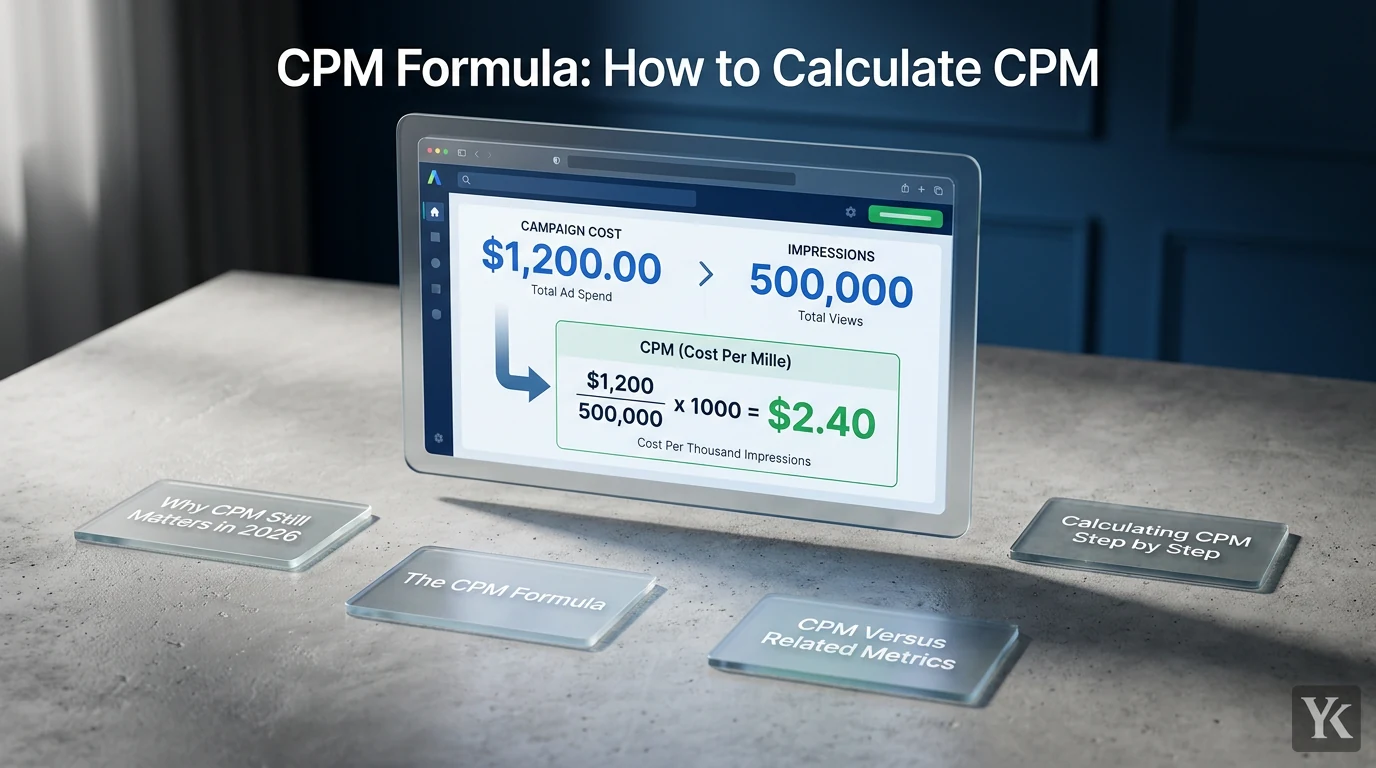
CPM is the average cost of 1,000 ad impressions: CPM = (Total campaign cost / Total impressions) x 1,000. A $2,400 spend that bought 300,000 impressions is an $8 CPM. Is that good? Expensive? Worth scaling? CPM alone only answers half the question, because the number that actually matters is what you paid per conversion, not per thousand impressions.
This guide covers the full chain: how to calculate CPM, what moves it, and how to bridge from impression cost to cost per acquisition. (CPM here is the advertising metric, not the Critical Path Method from project management or the Cpm process capability index.)
Why CPM Still Matters in 2026
On Meta and Google, impressions are getting more expensive, at least for ecommerce advertisers. Triple Whale's Meta Ads benchmarks, built from ecommerce brands that use its analytics platform, put the median Meta CPM at $15.06 for August 2025 through July 2026, up 13.24% on the previous 12 months. Its Google Ads benchmarks for the same period show a median CPM of $15.35, up 13.34%.
The medians hide a wide spread: on Meta alone, the year-over-year CPM change ranged from -6.61% to +33.33% across the 17 industries in Triple Whale's report.
Whichever way prices move, CPM is the unit impression-based media is priced in and the starting point for projecting what a customer will cost.
What Is CPM?
CPM stands for cost per mille, where mille is Latin for 1,000. Meta's Business Help Center calculates it as amount spent divided by impressions, multiplied by 1,000.
Impressions are not unique people. The same user seeing your ad four times counts as four impressions, so on a frequency-heavy retargeting campaign your CPM can look efficient while you keep hitting the same small audience.
The CPM Formula
CPM = (Total campaign cost / Total impressions) x 1,000
Two inputs and a constant:
- Total campaign cost: what you actually spent on media (leave out agency fees and creative production unless you're doing a fully loaded cost analysis)
- Total impressions: the impressions the platform reports for the same period (platforms don't all count an impression the same way; more on that below)
- 1,000: the multiplier that normalizes the cost to a per-thousand basis
The same formula also runs backward, for forecasting what a planned buy will cost or how many impressions a budget buys.
Calculating CPM Step by Step
Take the hypothetical $2,400 / 300,000 campaign from the top.
Step 1: Divide total spend by total impressions. $2,400 / 300,000 = $0.008 per impression (less than one cent)
Step 2: Multiply by 1,000. $0.008 x 1,000 = an $8 CPM
Now run it in reverse. What do 500,000 impressions cost at the same $8 CPM?
Estimated cost = (Planned impressions / 1,000) x CPM (500,000 / 1,000) x $8 = $4,000
Or start from the budget. How many impressions does $1,000 buy at the same $8 CPM?
Estimated impressions = (Budget / CPM) x 1,000 ($1,000 / $8) x 1,000 = 125,000 impressions
CPM Versus Related Metrics
CPM measures exposure; the other metrics measure what happened after it.
| Metric | What It Measures | Formula |
|---|---|---|
| CPM | Cost per 1,000 impressions | (Spend / Impressions) x 1,000 |
| CPC | Cost per click | Spend / Clicks |
| CTR | Click rate from impressions | Clicks / Impressions |
| CPA | Cost per conversion | Spend / Conversions |
| ROAS | Revenue relative to spend | Revenue / Spend |
Here is the thing: a low CPM does not mean a cheap acquisition. If the ad generates almost no clicks, or the landing page converts at a very low rate, even a modest CPM can produce a painfully high CPA. Chasing a lower CPM in isolation is the same mistake as judging a traffic source on click-through rate: neither tells you whether the traffic ever converts down-funnel.
What Drives CPM?
As AdRoll's State of Digital Advertising report puts it, CPM is determined by supply and demand. More advertisers bidding for the same inventory push prices up; more inventory with fewer bidders brings them down. Several factors layer on top of that baseline.
Audience specificity. A narrow, high-intent audience (say, in-market for enterprise software in a specific country) usually costs more per thousand than a broad interest-based audience. More advertisers want those people, and there are fewer of them.
Placement. Premium placements, feed positions, and high-engagement formats usually command higher CPMs than run-of-network inventory. Prices vary a lot even within one channel: on the native campaigns I've funded on Jubna, Taboola and MGID, CPCs ranged from about $0.03 to $0.40 depending on the publisher mix.
Geography. Advertiser demand differs by country, and so do prices. Google's AdMob help notes that eCPM, the revenue publishers earn per 1,000 impressions, is highly dependent on the market and can rise in one country while falling in another. In MENA, don't plan an Egypt budget from a Saudi or UAE CPM, or the other way around.
Seasonality. Q4 auction pressure is real. Google's Ad Manager seasonality guide says seasonal increases in traffic and CPMs generally begin in September, peak in late November and drop back to normal in January, as advertisers compete harder for inventory.
Campaign objective. Reach and awareness objectives often produce lower CPMs than conversion objectives, because the platform isn't hunting for the users most likely to act. You get more impressions per dollar, but less targeted ones.
Creative quality. Auctions reward predicted relevance, not just the bid. Meta's ad auction picks the ad with the highest total value, a combination of the bid, estimated action rates and ad quality, so a more relevant ad "could win an auction against ads with higher bids." Stronger creative can win impressions without raising your bid.
2026 CPM Benchmarks: Use Carefully
The Triple Whale figures above are medians from one analytics vendor's ecommerce customers for August 2025 through July 2026: estimates from a defined dataset, not official Meta or Google prices. The brands in the sample, their industry mix, geography, attribution windows and campaign objectives all shape the result, so a $15.06 cross-industry median says little about what your campaign will cost.
What the data does show is that CPM and CPA don't move in lockstep. Meta's median CPM rose 13.24%, but median CPA rose only 3.14%, largely because median CTR climbed 15.97% while median conversion rate slipped 4.73%. A more expensive impression doesn't automatically mean a more expensive customer, as the chain below shows.
Your own past campaigns are the better benchmark, matched on platform, objective, audience type and season. Comparing Meta CPM with Google Ads CPM misleads because the platforms don't count the same thing. Meta counts an impression when an instance of an ad first comes on screen, even if a video never starts playing. Google Ads' viewable CPM bidding for Display campaigns lets you pay only for impressions measured as viewable: at least 50% of the ad on screen for one second or longer (display), or playing continuously for two seconds or longer (video). Audience definitions and attribution differ too.
Can You Turn CPM Into CPA?
Not on its own. CPM prices exposure and CPA prices a conversion. Two variables fill the gap between them: click-through rate and post-click conversion rate.
The formula that bridges them:
CPA = CPM / (1,000 x CTR x Conversion Rate)
Where CTR is clicks divided by impressions and conversion rate is conversions divided by clicks, both expressed as decimals (1.5% = 0.015, 4% = 0.04).
The logic: 1,000 impressions cost one CPM and generate 1,000 x CTR clicks, which generate 1,000 x CTR x Conversion Rate conversions. Divide spend by conversions and you have CPA.
Before launch, it's a planning tool that projects CPA from assumed inputs. Actual CPA comes from your conversion data, checked against backend records.
Worked CPM-to-CPA Example
Inputs (hypothetical):
- CPM = $12
- CTR = 1.5% (0.015)
- Landing page conversion rate = 4% (0.04)
Per 1,000 impressions:
- Clicks = 1,000 x 0.015 = 15
- Conversions = 15 x 0.04 = 0.6
CPA = $12 / 0.6 = $20
That's the full formula, $12 / (1,000 x 0.015 x 0.04), one step at a time. The 0.6 isn't a literal partial conversion: over enough volume, it means one conversion for about every 1,667 impressions (1,000 / 0.6).
For a real-world check, plug Triple Whale's Google Ads medians for August 2025 to July 2026 into the same formula: a $15.35 CPM, 1.65% CTR and 3.11% conversion rate give $15.35 / (1,000 x 0.0165 x 0.0311), or about $30, against a reported median CPA of $28.14. They don't match exactly because each median is calculated separately, and medians don't multiply through a formula the way totals do. Treat it as a sanity check on the formula, not a target to copy.
Reverse-Engineering Your Targets
Fix a target CPA and any two of the three inputs, and the formula solves for the third. On an affiliate offer, set that target below the offer's effective payout, not its headline payout.
Required CPM: CPM = Target CPA x 1,000 x CTR x Conversion Rate
Required CTR: CTR = CPM / (1,000 x Target CPA x Conversion Rate)
Required conversion rate: Conversion Rate = CPM / (1,000 x CTR x Target CPA)
Example (hypothetical inputs): You want a $25 CPA. Your CPM is $10. Your landing page converts at 4% (0.04).
Required CTR = $10 / (1,000 x $25 x 0.04) = $10 / $1,000 = 0.01 = 1%
So you need at least a 1% CTR to hit a $25 CPA. CPA moves inversely with CTR: at a 0.5% CTR, the same inputs give a $50 CPA. Lift the conversion rate to 8% and a 0.5% CTR is enough to hit $25.
How to Calculate CPA Directly
When you have actual campaign data, skip the projection formula.
CPA = Total campaign cost / Total conversions
Google Ads Help defines average CPA as the average amount you've been charged for a conversion, calculated by dividing the total cost of conversions by the total number of conversions. The same definition applies whether you're buying on CPM, CPC, or any other pricing model.
The critical variable is what counts as a conversion. A purchase, a qualified lead, an app install and a newsletter signup are all trackable, but their downstream values differ widely, so a CPA that doesn't name its action is technically correct and practically useless.
Platform-reported and backend-verified conversions are also rarely the same number. Attribution windows, view-through credit and cross-device matching let a platform count conversions your CRM would credit to another source, or can't tie to an ad at all. Reconciling the two takes click data in your backend: the Google Ads tracking template guide covers passing gclid and UTM parameters to your CRM so conversions can be matched to the campaigns that drove them. Set that up before launch, not after the numbers disagree.
CPM-to-CPA Spreadsheet Setup
For actual campaign data, a working sheet needs these columns:
| Column | Formula |
|---|---|
| Spend | Input |
| Impressions | Input |
| CPM | =Spend/Impressions*1000 |
| Clicks | Input or Spend/CPC |
| CTR | =Clicks/Impressions |
| Conversions | Input |
| Conversion Rate | =Conversions/Clicks |
| CPA | =Spend/Conversions |
| Revenue | Input |
| ROAS | =Revenue/Spend |
Keep three tabs: forecasts (pre-launch projections), platform-reported data, and backend-confirmed conversions. In the forecast tab, CPM, CTR and conversion rate are your assumptions, so CPA is =CPM/(1000CTRConversionRate): the same calculation as Spend/Conversions rearranged, which is why the two always agree on actual data. The gap between the platform and backend tabs is your attribution discrepancy, and it matters for any decision about scaling or cutting a campaign.
Common Calculation Mistakes
Each of these produces a wrong number:
- Forgetting the 1,000 multiplier. Spend divided by impressions is the cost per impression: $0.008 in the example above, which is an $8 CPM.
- Mixing impressions and reach. Impressions count every time the ad is shown; reach counts unique accounts. Put reach in the formula and you get Meta's separate cost per 1,000 Meta Accounts reached, which works out to CPM times frequency and is never lower than CPM.
- Inconsistent spend definitions. Using gross spend (including taxes and fees) for one campaign and net media spend for another makes comparison meaningless.
- Comparing different attribution windows. A 7-day click window counts every conversion a 1-day click window does, plus later ones, so the same campaign shows a lower CPA under it.
- Blending incompatible campaigns. A blended CPA across a brand awareness campaign and a direct response campaign represents neither.
- Too few conversions. CPA estimates based on 3-5 conversions have enormous variance. Wait for statistical stability before drawing conclusions.
- Ignoring fees. Agency fees, tools, and creative production are real costs. Media-only CPA is fine for comparing campaigns, but leave those costs out when judging profitability and your CPA is understated.
Lowering CPA Without Chasing Low CPM
The CPA formula has three levers, and CPM is often the hardest to control directly.
CTR is a function of creative quality, audience relevance, and placement. If a better hook or a more specific audience doubles CTR while CPM and conversion rate hold, CPA halves. (CPM can move too, since Meta's auction factors in how likely people are to engage.)
Conversion rate is a function of landing page speed, message match, offer clarity, and friction, and it carries the same weight in the formula: double it and CPA halves, whatever the CPM.
A higher CPM is acceptable if it buys a better audience. With a hypothetical 1% CTR on both, a $20 CPM on a narrow, high-intent segment converting at 8% gives a $25 CPA, while an $8 CPM on a broad audience converting at 1% gives $80. The native ads affiliate marketing launch plan runs this chain for native traffic and reaches the same conclusion: the placement mix, not the bid, decides your CPA.
The real question is not "how do I get a lower CPM?" It's "which combination of CPM, CTR, and conversion rate produces my target CPA?"
Is Your CPM Actually Good?
A five-step check:
- Define the objective. Awareness campaigns are judged on reach and completed views, acquisition campaigns on qualified conversions, so the right CPM benchmark differs.
- Calculate CPM consistently. Same spend definition, same impression source, same date range.
- Check CTR and conversion rate. A CPM in isolation is half a sentence.
- Calculate CPA and downstream quality. What did each conversion cost? What was it worth?
- Compare against your own historical baseline, not a published average.
Frequently Asked Questions
What is a good CPM for digital advertising?
There is no universal answer. Triple Whale's benchmarks for August 2025 through July 2026 show median CPMs of $15.06 on Meta and $15.35 on Google Ads, but those are cross-industry medians from one vendor's ecommerce customer base. Your relevant benchmark is your own historical CPM in the same platform, objective, and audience type. A hypothetical $5 CPM that produces a $100 CPA is worse than a $20 CPM that produces a $15 CPA.
Does CPM include clicks?
No. CPM is purely an impression-based metric. If you're billed on impressions, as with Telegram's CPM-billed sponsored messages, you pay for every 1,000 impressions whether or not anyone clicks. CPC (cost per click) is a separate pricing model where you pay only when someone clicks, but you can still work out the effective CPM of a CPC buy: CPC x CTR x 1,000. A hypothetical $0.50 CPC at a 1% CTR is a $5 effective CPM.
How many impressions do I need to estimate CPA reliably?
Enough to produce a stable conversion count from a consistent traffic source. There's no official threshold, but the random swing in a count of n conversions is about the square root of n: roughly ±45% at 5 conversions, ±18% at 30 and ±10% at 100. Convert that to impressions with your CTR and conversion rate: at the worked example's hypothetical 1.5% and 4%, 30 conversions take about 50,000 impressions (30 / 0.0006).
What is the difference between CPM and tCPM?
CPM is a metric (what you paid per 1,000 impressions). Target CPM (tCPM) is a Google Ads bid strategy for video campaigns: you set the average CPM you're willing to pay, and Google Ads bids to reach more unique users while trying to keep your average CPM at or below it. One is a measurement; the other is a campaign setting.
How do I calculate CPM from a known CPA?
Rearrange the CPA formula: CPM = CPA x 1,000 x CTR x Conversion Rate. If your target CPA is $20, CTR is 1.5% (0.015), and conversion rate is 4% (0.04), then CPM = $20 x 1,000 x 0.015 x 0.04 = $12. That's the highest CPM you can pay and still hit a $20 CPA at those performance levels.
Putting It Together
The CPM formula is simple math. CPM measures the price of exposure, not the cost of acquisition, and getting from one to the other takes CTR and conversion rate, which your creative, audience and landing page determine.
Set your CPA target before you launch, work backward through the formula to the CTR and conversion rate you need at your expected CPM, then track actual performance against those inputs.
The automated lead generation workflow makes the same point from the lead side: decide what counts as a qualified lead before launch, then judge every channel on cost per qualified lead. The math only works if you know what you're counting as a conversion from day one.
Digital Marketing Technologist
Yosef Kassabry is a media buyer and full-stack developer with 11+ years in paid acquisition for Arabic-speaking audiences across MENA and the Gulf, and more than $10M in managed ad spend. He runs paid media through direct buys and affiliate networks, builds his own tools, and writes about ad platforms, tracking, native ads and affiliate marketing.