What is CPA marketing? CPA has two meanings. As a metric, it's cost per acquisition: ad spend divided by conversions. As an affiliate pricing model, it's cost per action: an advertiser pays a fixed amount each time a referred user completes a defined action, a network tracks it and pays it out, and the affiliate sends the traffic.
This guide is written from the side that buys the traffic: the payout on the offer page is where the math starts, not where it ends. Caps, scrubs and holds all sit between that number and the money that reaches you: scrubs cut what each conversion is worth to you, caps limit how many can earn, and holds tie up your cash.
What Is CPA Marketing? The Offer's CPA vs Your Ad Account's CPA
CPA in affiliate marketing involves three parties. The advertiser decides which action it will pay for and what that action is worth. The network hosts the offer, tracks conversions and pays affiliates, keeping a margin between what the advertiser pays it and what it passes on. The affiliate sends the traffic and carries the risk: if visitors don't complete the action, the affiliate eats the cost of the clicks.
Then there's the CPA in your ad account. Google Ads calculates average CPA as the total cost of conversions divided by the number of conversions, and Meta's cost per result is amount spent divided by results. Google's own glossary expands it as "cost per action", so don't lean on the expansion. Lean on the direction of the money: the platform's CPA is what you pay, and the offer's CPA is what you're paid.
Both platforms will also bid toward a CPA you choose. Google's Target CPA strategy sets bids to get as many conversions as possible while trying to keep your average cost per conversion at the target, and Google says some conversions may cost more than the target and some less. (Starting in June 2026, Google is relabeling "Maximize conversions with a Target CPA" as "Target CPA" and says the bidding behavior is unchanged.) Meta's cost per result goal works in a similar way around a target average cost per result, and Meta notes that your actual weekly average may vary from the goal.
Here is the thing: the platform only knows the event you report to it, often the form fill or the install. The offer pays on the event it validates, which may be an approved lead, a confirmed opt-in or an install that survives a fraud check. Profit sits in the gap between the two CPAs, and that gap is smaller than the offer page suggests. The rest of this guide is about how much smaller.
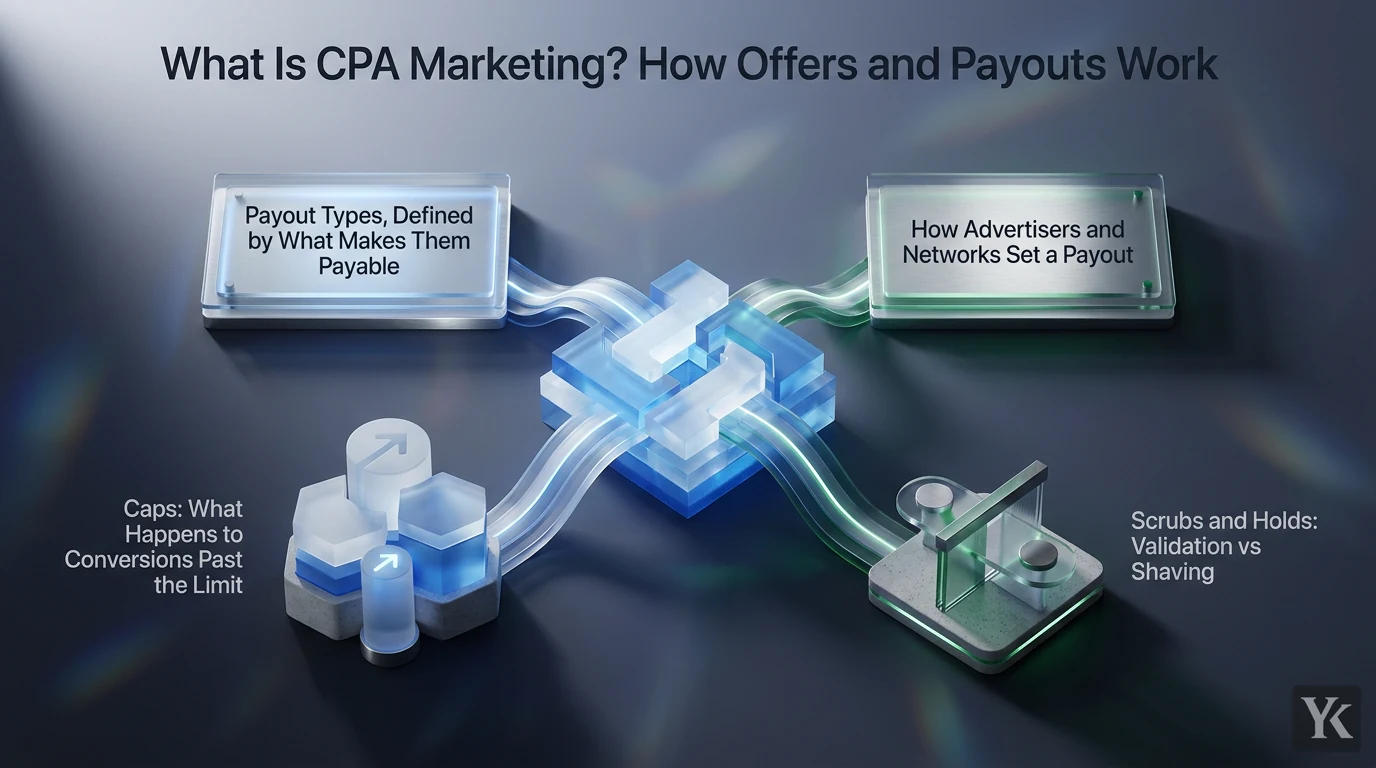
Payout Types, Defined by What Makes Them Payable
Offer pages sort payouts by acronym. It's more useful to sort them by the moment a conversion becomes payable, because that decides how long you wait and what can still be taken back.
| Type | Payable event | Why a conversion may not pay |
|---|---|---|
| CPL (cost per lead) | A lead the advertiser accepts under the offer's criteria | Duplicates, fake or incomplete details, out-of-geo leads, banned traffic |
| SOI (single opt-in) | The submitted sign-up itself | Fake or duplicate sign-ups |
| DOI (double opt-in) | The click on the link in the confirmation email | People who sign up and never confirm |
| CPI (cost per install) | An install the advertiser's attribution platform credits to your click | Installs blocked or later flagged as fraud |
| CPS (cost per sale) | A completed, paid order | Refunds and chargebacks, where the terms claw them back |
| Approved-lead COD | A cash-on-delivery order the advertiser confirms with the buyer after the form fill | Buyers who can't be reached or cancel at confirmation |
The SOI and DOI split follows how email platforms define opt-in. In Mailchimp's definitions, single opt-in adds a subscriber as soon as the form is submitted, while double opt-in requires a click on a verification link in a confirmation email. Every DOI payout sits behind a step you don't control.
On CPI offers measured by an attribution platform, the install counts when that platform credits it to your click, not when your tracker records it, and the platform can flag a credited install as fraud later (more on that under scrubs).
On CPS offers, an approved sale can still be taken back. Everflow, a partner marketing platform that networks and advertisers run offers on, documents a reversal postback that rejects approved conversions after a refund, cancellation or chargeback, and a partner who was already paid for them sees a clawback. Read the offer's refund terms before you treat a sale as final.
On an approved-lead COD offer, the form fill is only an order request. The payout comes only once the advertiser reaches the buyer and confirms the order, so a lead it can't reach, or who changes their mind, pays nothing, however clean your traffic was.
How Advertisers and Networks Set a Payout
The advertiser starts from what the action is worth to it. Shopify's guide to CPA marketing points merchants to average order value and customer lifetime value when they set CPA offers: an attractive commission on the first purchase for high-margin, infrequent buys, and a recurring commission when a subscription's lifetime value dwarfs the first order. A lead is worth what the advertiser expects to earn from the share of leads that become customers, and the payout has to leave the advertiser a margin after that.
The network then decides how much of that to pass on. In Everflow's setup, each offer carries two numbers: revenue, the money earned from a conversion, and payout, the money paid to the partner who drove it. When a network runs the offer, the gap between the two is its margin. Everflow's Partner Tiers feature can calculate payouts automatically from a margin goal. In its own example, $1 of revenue at a 30% margin leaves a $0.70 payout. Partners don't see tier information in their portal, and custom payouts for individual partners override the tiers.
So the payout you see is a setting, not a market price. Two affiliates on the same offer can be paid different amounts. Everflow's example tiers put new sign-ups on a default tier with a lower revenue share "until proven" than established partners get, so clean, consistent volume is the argument to bring when you ask for a payout review.
Caps: What Happens to Conversions Past the Limit
A cap limits how much an offer will take in a given period, counted in clicks, conversions, revenue or payout. What happens to traffic after the cap is hit depends on the tracking platform and how the network set it up, so read the offer's cap terms instead of guessing.
Everflow's caps documentation shows how one platform handles it:
- Caps can be set per offer, per partner or across a group of offers, and the system enforces whichever cap is reached first.
- A hard cap stops tracking as soon as the limit is reached, and later traffic is marked as invalid clicks.
- Conversions that land during the roughly two-minute enforcement delay show as Pending with an "Over Caps" message, and the network can approve or reject them manually.
- A soft cap only sends an alert when the limit is reached, and traffic keeps flowing normally. Soft caps aren't on by default.
- The network decides whether partners can see offer caps in their own portal.
Other platforms may handle the overflow differently, but the buying-side risk is the same: your ad account doesn't know the cap exists. Once a hard cap is hit, every click you keep paying for can't earn on that offer. Ask where the cap is shown and whether you'll be alerted before it's reached, and size your daily budget so that, at your current cost per conversion, you can't buy much past it.
Scrubs and Holds: Validation vs Shaving
A scrub is a recorded conversion that doesn't pay in the end: rejected at validation or reversed after approval. A hold is a conversion that's recorded but not payable yet. Both are a normal part of CPA, and both can be abused.
Legitimate validation looks like this: the advertiser rejects duplicates, fake or incomplete details, leads from outside the offer's geo and traffic from sources the offer bans, and it should be able to tell you which conversions it rejected and why. On app offers, the check can land after the install is already in your stats. AppsFlyer's Protect360 guide says post-attribution fraud "can be identified on the day of the install, and up to 7 days after (8 days total)", and that fraudulent installs and in-app events identified in retrospect "must be treated as real fraud and not charged for." Once a source is flagged, its future clicks are blocked, and its installs from the start of the current calendar month are labeled as post-attribution fraud. The guide's reconciliation steps have advertisers contact each network where fraud occurred at the start of each month and share the raw data. A CPI conversion you saw this week can still be reversed in that reconciliation, and the offer terms decide whether the reversal reaches your payout.
Holds are the waiting room: recorded, not yet validated. A tracker can keep them apart from confirmed money if the network's postbacks carry a status. In Keitaro's postback documentation, for example, the tracker records a Lead with the payout unconfirmed and its revenue in a "Revenue (hold)" metric, then overwrites it as a Sale (payout confirmed) or Rejected (payout canceled) when the network's next postback for that click arrives. Budget from confirmed revenue, not from revenue on hold.
Shaving is different: valid conversions removed with no reason you can check, or approved commissions that disappear without explanation. The warning signs of commission shaving are covered in the scams guide. Your defense is data: pass your own click ID and sub-IDs on every click, so you can ask for rejection reasons conversion by conversion. Set that up before the first dollar is spent, not after the first dispute. If you don't have a tracker yet, the free affiliate tracking software guide separates campaign trackers for media buyers from tools for running a program.
From Headline Payout to Effective Payout
Put the pieces together and you get the number to plan with. An illustrative formula:
Effective payout per recorded conversion = headline payout × approval rate × (1 - scrub rate)
- Approval rate is the share of recorded conversions that pass the advertiser's validation.
- Scrub rate is the share of approved conversions reversed later, such as fraud flags, refunds or chargebacks. Rejections at validation are already in the approval rate, so don't count them twice.
- Caps sit outside the formula. Once a hard cap like Everflow's stops tracking, extra traffic doesn't convert at a lower rate; it doesn't earn at all.
A hypothetical example: a $20 CPL offer, a 70% approval rate and a 10% scrub rate.
- Effective payout: $20 × 0.70 × (1 - 0.10) = $20 × 0.70 × 0.90 = $12.60 per recorded lead
- If you set your platform target at the $20 headline and hit it, you lose $7.40 on every recorded lead ($20 - $12.60)
- If approval drops to 60%: $20 × 0.60 × 0.90 = $10.80, so a $12.60 platform target now loses $1.80 per recorded lead
That $12.60, not $20, is the most you can pay per recorded lead in Google or Meta and still break even before tools and fees. Multiply it by your click-to-lead rate to get a break-even CPC (at a hypothetical 5%, $12.60 × 0.05 = $0.63); the native ads guide works through the click math step by step. On a CPM buy, the CPM-to-CPA formula turns the same $12.60 into a maximum CPM, using your CTR and click-to-lead rate.
The money also arrives late. If an offer pays net-30 on a monthly cycle, meaning 30 days after the month closes, a conversion on the first of the month gets paid about 60 days later. Keep buying traffic in the meantime and you'll have roughly two months of spend out before the first payment lands: at a hypothetical $150 a day, about $9,000 (60 × $150), and more if the offer adds a hold period. At break-even it all comes back, eventually. At a loss, only part of it does.
How CPA Offers Change by Country
The mechanics above don't change by country. What can change is the payout itself and the event it's paid on, so check both for every country.
- The payout can differ by country. Everflow lets a network restrict a custom payout by geography, so the same offer can pay one amount in one country and a different amount in another. Check the payout for each country you plan to buy.
- Compare like with like. Before you compare payouts across countries, check what each one is paid on: a paid order (CPS), an approved lead or a confirmed cash-on-delivery order. A higher payout on a harder event can be worth less.
- On approved-lead COD offers, the confirmation is the payout event, wherever you run them. Your economics depend on how many orders the advertiser confirms, not how many forms you collect, so ask how it confirms orders before you trust a lead count.
- The lander decides whether any of this matters. A lander in the buyer's language has to be written for that market, not translated into it.
Offer Terms to Check Before You Run Traffic
The scams guide covers how to vet a program. This list is narrower: the offer-level terms that decide whether the traffic you're about to buy can earn anything.
- Traffic sources. Which are allowed and which are banned, in writing. Conversions from a banned source are the easiest scrub there is.
- Geo. Which countries pay, and how much each one pays. Leads from outside the offer's geos can be rejected.
- Payout event. Form fill, approved lead, confirmed opt-in, attributed install or paid order. Build your platform target from the effective payout on this event, not from the headline.
- Cap. Daily or monthly, per offer or per affiliate, and how you'll know when it's close.
- Holds and payment terms. How long conversions stay pending, the pay cycle, the net terms and any minimum payment.
- Brand bidding. Whether you can bid on the advertiser's brand name in search. If the terms don't say, ask before you touch search.
- Landing pages. Whether a pre-lander is allowed. On Google Ads, the page also has to meet Google's Destination requirements, which list destinations "solely designed to send users elsewhere" among the reasons for disapproval.
- Disclosure. Any page of yours that promotes the offer needs a clear affiliate disclosure. Here is how to word and place one.
Frequently Asked Questions
What is the difference between affiliate marketing and CPA marketing?
CPA marketing is a kind of affiliate marketing. Affiliate programs pay in several ways: a percentage of each sale (revenue share), a flat amount per action (CPA), or a mix of the two. CPA marketing is the flat-per-action part, often run on paid traffic and paid on a validated event such as an approved lead or an attributed install.
Is CPA marketing legit?
Yes. CPA is a pricing model, not a scheme: an advertiser pays for a defined, validated action. The risk sits with individual programs and offers, such as terms that let approved commissions vanish without a reason, fraud clauses vague enough to reject anything, or payments that keep slipping. The scams guide linked above covers the warning signs. In the US, if you promote offers on your own pages, the FTC expects you to disclose the affiliate relationship clearly and conspicuously (FTC endorsement guides FAQ).
Does CPA marketing pay?
It pays when your effective payout stays above your cost per recorded conversion, with room left for tools and fees, and when you have the cash to wait out holds and payment terms. Nobody can tell you in advance whether a given offer will clear that bar, which is why the campaign numbers in this guide are labeled hypothetical. Work out the effective payout before launch, test with a budget you can afford to lose, and set your kill threshold before the first click.
The headline payout is a starting point. Take off rejections and reversals and you have the effective payout, the number your ad account's CPA has to stay under. Then stop buying at the cap, and fund the weeks your money sits on hold.
Digital Marketing Technologist
Yosef Kassabry is a media buyer and full-stack developer with 11+ years in paid acquisition for Arabic-speaking audiences across MENA and the Gulf, and more than $10M in managed ad spend. He runs paid media through direct buys and affiliate networks, builds his own tools, and writes about ad platforms, tracking, native ads and affiliate marketing.